

 YouTube

 Apple Podcasts

 Spotify

 RSS Feed

 Spreaker

 iHeartRadio

 Castbox

 JioSaavn

 Pandora

 Deezer

 Podcast Addict

 Amazon Music

A Timeless New Year's Message Revisited
Happy New Year, 2025!
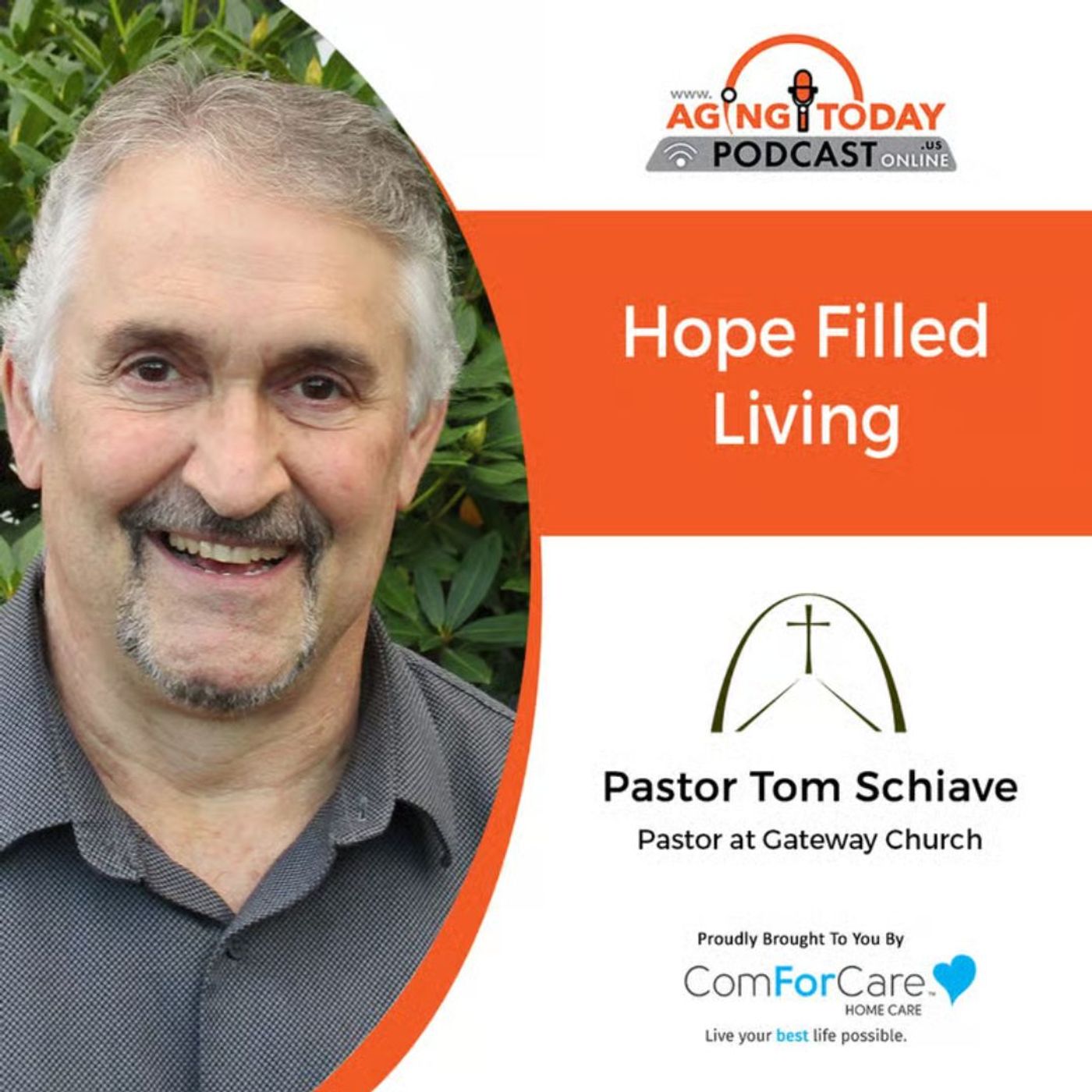
We're revisiting an inspirational conversation with Pastor Tom Schiave from our New Years celebration in 2024.
Pastor Tom Schiave Gateway Church Pastor brings our traditional New Year's message for 2024. To help us start the...
Happy New Year, 2025!
We're revisiting an inspirational conversation with Pastor Tom Schiave from our New Years celebration in 2024.
Pastor Tom Schiave Gateway Church Pastor brings our traditional New Year's message for 2024. To help us start the new year right, Tom inspires us with a message of hope. In light of what seems to be living in an upside-down world, it is possible to live with hope. However, having the right kind of hope can make all the difference in the world. Some people are "hope so" people, while others may respond by being "hopeful." Then there are people whose hope is tethered to an unwavering God. These people experience "hope-filled" living. Click AgingToday.us & listen today!
Thank you to our sponsors, ComForCare West Linn and Royal Hospice Oregon!
Buy Mark a Coffee - Support Our Content About Aging!

Like and share Aging Today podcasts with your friends and family!
www.AgingToday.us
0:00 [music] You're listening to Aging Today, the podcast where together we explore the options to aging on your terms. When I get older, lose a fire, many years from now, we used to be sending me a fountain for a day, greetings out of wine, if I did I'd kill quarter of three would you like to do? Will you still leave me, will you still leave me when I'm sixty four?
0:42 And now the podcast where together we discuss proactive aging on your terms, connecting to the professional advice of our special guests while creating better days throughout the aging process. Now here's your host, Mark Turnbull. And welcome back to another lively discussion on Aging Today, we are the podcast where together we explore the many options to aging on your terms. You can find aging today and our seven and we are now eight years of past program because this is January 1st and we have been eight years amazing on this podcast, Aging Today.
1:24 And you can go to our website and pick up all of the past programs, all you got to do is go to agingtoday.us. And then for those of you that want to follow us on your favorite podcast channel, we are on about fifteen different podcast channels, Spotify, Pandora, Apple, I Heart, YouTube, I mean there's so many that we're on all you have to do is type in aging today, become a follower. We have about 200,000 followers across the United States and we are so grateful for every one of you. And we hope that we can continue in 2024 and bringing you all of the experts on the aging process that are going to be able to answer your questions.
2:08 And then we do want to know what your questions are on aging. So reach out to me. And then if you also have aging experts that you would like to introduce to me, your host, Mark Turnbull, I would love to hear from you. All you got to do is email me its mark@agingtoday.us. It's Mark with a K at agingtoday.us. Well this is the new year program and last week we had a great discussion with Tom Pastor Tom Shive of Gateway Church in Portland, Oregon and we're going to have another tradition that we're going to carry on.
2:48 We've been doing this for seven years. Tom has been our messenger for the new year message and that doesn't, we're going to continue that tradition on this year in 2024 as well. Pastor Tom Shive, welcome to agingtoday. Well, it's good to be back another year. So we're looking forward to being together another year and yeah, seven years we've been doing this mark and it's great. Great. Always good to get together with you and always good to be part of agingtoday. So yeah, new year, 2024. I'm honest. Wow.
3:28 You know, and I look at our culture and what's going on and there's a side of me that is optimistic but there's also a side where I've got a lot of questions and there's a lot of despair. I'm really torn what's going on and I'm torn because I see things changing so rapidly. What was once right is now wrong. What is wrong in my past and the 66 years that I've been walking this earth is now right.
4:09 And I, what is up and it's down and what is down is up and it's very, very confusing and the world is changing at such a rapid rate and I know that technology plays a large role in that but there's so many ideologies that we once talked about but now they're embedded into our culture, they're embedded into our system and the changes are happening so rapidly that sometimes even myself I get overwhelmed and I can only imagine those that don't have any kind of a spiritual foundation, how much they must be feeling that as well.
4:52 So we're going to talk about an important word that is I think going to help us to put some perspective around what's all the chaos that is going on in our culture in Western civilization especially and maybe we can put some context to that. How does that sound, Tom? Sounds great. Yep. We've got that word right here. What is that word? Well, the word is hope. That's what we want to talk about today, where does our hope come from because right now there's a lot out there are a number of people who are just losing hope. There doesn't seem to be easy answers or solutions.
5:33 There doesn't seem to be anchors that are holding people. I've talked about this a little bit saying that right now most of life seems a bit unmoored. Maybe even 50, 60 years ago there was kind of a framework that we had and the framework was the Judeo-Christian ethic. Not everybody is a Christian and not everybody is Jewish but this country was founded with a framework of the Judeo-Christian ethic around it. So anything that went on could easily be done or worked on within that framework but that framework seems completely gone.
6:13 There doesn't seem to be anything that's holding anything together. There just seems to be this sense of unmoored. There's just change constantly. Just when you think you've got to handle on something it all changes and technology is that way. Yeah, I just a dear friend of mine got hacked on Saturday night, horrible. It made his life for that Saturday night and part of Sunday morning, a miserable, miserable time. There doesn't seem to be any particular focal points people are looking at. Things are decisions are made just upon a sort of consensus without really looking at anchor points.
6:58 There are no guardrails. There's just no guardrails. If you think about when I drive, I drive over the Glen Jackson Bridge. We all drive over the Glen Jackson Bridge because there are lanes and there's also guardrails on the side. I was thinking, what if they took those guardrails off the side? How would people drive? Yeah. Really slow. I mean, you would be afraid if those guardrails were not on the side of the road. You would be terrified. And there just seems to be no guardrails out there. There doesn't seem to be lanes. It all seems to just be an unmarked highway where there are no speed limits anymore or there are no stop signs or anything.
7:45 Life is just going in a series of chaotic adventures without any guidelines. And people are feeling that kind of unmoored and I think lots of things are causing that. Yeah. And I like the other term that you used anchor. Yeah. But you had unmoored and moored and anchor things that brought us organization into our world. And it seems like a lot of the organization, like you were saying, is gone. It seems to be disappearing or at least it's changing. It is changing, but for example, if we look at some of those anchors and we'll talk a little bit about them.
8:31 If you look at some of the anchors that we used to have, it used to be the anchor of God. God used to be an anchor. Everybody looked to. He was stable and we're going to talk more about him later and about the necessity of a good relationship with him. God was one of those anchors, but guess what? That's no longer the case in our culture. Yeah. Government was one of those anchors. We felt like at least we had a government that was stable that was for the people, by the people, for the people, not anymore. We feel like our government is just making all sorts of decisions using money, spending, getting us into incredible deficits that are going to all come back to us. We fear that.
9:12 Government was one of those things, but a lot of people now have no trust in the government or the institution of the government. Parents used to be that way, but parents' rights now are now being challenged. Public schools are taking over and they're telling parents what they have to do, how they have to train their kids or public schools are going against the parents. I was thinking about when I grew up, my dad and the local school on my grade school were tight. They were tight. If the teacher called my dad, that was the worst thing in the whole wide world because my dad and the teacher were always right.
9:53 My dad never had to argue with the teachers because the teacher and my dad were on the same place with what they wanted for me. I would do anything to not have the teacher calling dad because the teacher was always right. My dad would be upset, but now teachers go against the parents instead of working for them, not all of them, not all of them. There's great many out there that are really doing a good job, but there's a number of ethical issues and things. That's another one. It seems like the only thing is God still can be personally an anchor for people and the local church is that anchor in culture still.
10:35 They're still the church out there. But this is this feeling of just man, inflation is one of those things that makes people feel more, I'm not making enough money. Media is just loaded full of negativity. The whole world is just collapsing. If you think about global climate change, I believe in global climate change. I'm not a climate alarmist. I'm not a guy that thinks that the world is going to end in 10 years. I think that industry has always worked at helping with the climate. I was talking to somebody about that the other day.
11:18 You saw the cars on the highway. You see any missions coming out of them? No. When I was a kid, emissions were pouring out of the back of my dad's old 71 Chevy. You saw, I never see it. If I'm driving down the highway, where do I see even a puff of smoke out of anybody's car? You've got global climate change that's providing it and the political climate, just the whole supply, distrust of Washington and what's going on there. The lack of unity there is causing a lot of people to feel unmoored. I think there's some concerted efforts by some people around the world to bring as much chaos into the world.
12:02 We saw that over the last couple of years with the Antifa movement and trying to take away and creating more chaos. In the midst of all that chaos, people begin to lose hope. They begin to take their eyes off of the ball, so to speak. I think that there's concerted efforts to do that, to change our society and to, there seems to be, from my perspective, anyhow, there seems to be a movement towards removing all things with a Judeo-Christian philosophy behind them of organization.
12:49 There seems to be an effort to want to remove that. Well, that's because that's, that some people see that as restrictive and they don't want restrictions. They think that, they think that freedom is doing what I want to do. Freedom is doing what we ought to do. Yeah. That's true for me. Well, that's like the guard rails on the bridge. Yeah. Guard rails and you got more freedom to, you know, but there's consequences to unrestricted freedom. Exactly. And you say freedom, freedom again is not the ability to do what you want, it's the ability to do what you ought to do within the context of a culture. And that's, that's part of the problem. You're right.
13:30 I think there is a concerted effort to move away from the Judeo-Christian values, not, not every person in this country who founded this country was a Christian, but they grew up in a framework of that. So even though, because our whole judicial system is tied into that, the whole thing, the whole, the laws that are in our judicial system is tied into that, the whole government structure is tied into one thing that power corrupts and absolute power corrupts absolutely. So that's why you have a house and that's why you have a senate. And that's why you have the different executive branch. The executive branch. And that's why you have a judicial, legislative and executive branch because nobody gets the power completely.
14:15 Yeah. And it's all based upon the fact that power corrupts and sin is a terrible, powerful thing when a person uses it for the wrong reasons. That's, it's based upon how men cannot make good decisions. And as a result of that, we built the world's greatest generation. And the world's greatest country. And people from all over the world that have not had that kind of opportunity to live in a free society are wanting to come here. That's why there are so many people banging down our border right now because they are fleeing from the oppression of these other governments. And yet I find it ironic how we are moving away from that kind of, Judeo-Christian values and law, the judicial system and moving towards whatever Marxist philosophy or communist philosophy, whatever you want to call it, "Whoa, philosophy, ideologies that are out there that are trying to take over."
15:29 And there's a big, big movement to do that. So as a result of all that, I don't want to get too deep in the weeds there politically, but there's consequences, just like there are consequences, you take the guard wills off the, I love your analogy of the bridge. And there's consequences to that. And those are there to protect us. Our laws are there to protect us. Yet we seem to be really focused on trying to tear them down and to move towards something else, I don't know what you're going to fill this, the vacuum up with, but that's where our society is. So as a result of all that, people feel helpless, they feel hopeless.
16:15 And so that's where we want to go. We want to go today in spite of how you want to paint the picture and interpret what's going on in our culture. We're moving towards something that is driving more and more people towards helplessness, hopelessness. And so let's get into it. Yeah, I think you said it well earlier. You talked about chaos. That's how people feel. They feel chaotic and they don't feel like they can have any place to go to find answers or stability. They're just as, it's so, so difficult. Chaos. It's almost bordering anarchy.
16:55 That's what's a difficult thing when you don't have those guardrails, when you don't have those lanes, all you have is anarchy and chaos. And that's not how the human spirit works. The human spirit works in order. There's got to be some order there so we can thrive. So what does the Bible say? What is, what do you as a Christian, what do you believe in hope? What is hope to you? Well, if we look at it, hope is just pretty much a strong and confident expectation in an unwavering trust in the unchanging character of God. So you're putting your trust and your expectation in God Himself.
17:42 And it's a strong confidence in God and who He is and that He has control, that He has life, that He has a way, that He's given us scripture and the Bible, not as rules and regulations, but He's given us the Bible to understand story and help us to live the kind of lives that provides true freedom, you know? And the hope is found in Him. Notice it, I defined it as a strong and confident expectation. We just know something else is coming and we have this expectation. God's going to do something. The life is not completely out of control because there is God and He is on His throne.
18:22 And notice it also says there that He is, we put our unwavering trust in His unchanging character where everybody else changes, culture changes, God doesn't change. So that's the light. And I like to look at it as a lighthouse. I love the analogies of lighthouse. Yeah. That it kind of guides us, you know, and that's where the hope can kind of finish. Absolutely. That's if that's the standard, the standard bearer of what hope is. Let's go back then and in the midst of all this chaos, you know, some people feel hopeless. They do. They've given up.
19:03 To find, what does that mean? Well, they've given up. They just, they have absolutely no confidence that anything is going to change. They feel the sense of inter-anxed, you know, that life is just absolutely chaotic. It's unmoored. I have no hope that any human is going to do anything about this. I have no hope that the government is going to do anything about this. There is no place to have any confidence that anything is going to change and that anything is going to happen in a positive way. They're just flat out as you said. They're just hopeless. There's a sense that I'm hopeless.
19:44 This is where some of the chaos goes when you have a husband who shoots, you know, his wife. I mean, he loses his job and that's it. I can't. I'm hopeless. I'm nowhere to go. And so he destroys his family because he feels like it's better they'd be destroyed than we live. We have no hope that anything is going to change. Yeah. A person, it's a tragedy, Mark, but we all know you suicide is up. Because they are just living in this culture of inflation and their parents feel hopeless and they find no light at the end of the tunnel. There is no lighthouse for them.
20:24 It's all just this sailing on a ship. There's no lighthouse. The waves are crushing to get and see sick and there's no, it's not going to stop. And where do we go? Cultures not providing any directives that way. Not in science, not in technology. People are trying those things. It's not filling that sense of void people feel. Yeah. Yeah. Hopelessness is, it's the Bible says, hope deferred makes the heart sick. Hope deferred. In other words, you can put on your hope. You can say, I hope, I hope. And eventually, eventually, you get sick. The Shawshank Redemption is a great example of that.
21:05 That movie is all about hope. And they say, hope is a dangerous word and you don't use it here in the prison because there's no hope here. You have no hope in this prison at all. You're just going to be here. But it's the number one most watch cable movie. The Shawshank Redemption because it's so full of hope. Andy DeFrain believes in hope, which is why he can be in this prison cell, which is very hopeless and he's in Shawshank, which is horrible. And for 21 years, he takes a spoon and digs a hole in the wall for 21 years.
21:47 And he drops the rock side of his pants and nobody knows he's doing it because he has a hope. He has this hope, but it's a very hopeless place. So Andy has a different kind of trust. He's got a different sense that more, there's more to life. And that's not out there right now. People get pessimistic about it. So there's always going to be in this world. There's going to be world events, right? There's always going to be chaos because we live in a very malevolent world in many, many respects. And it's just a matter of time before you or I begin to experience that.
22:29 So it's there and what you're saying is then whose responsibility, how do we respond to that, that world of malevolence? How do we respond and many people choose hopelessness? Hopelessness. Yeah. What are the ways do people live in it? Well, there's others who are a bit pessimistic. You know, a pessimist at least sees the glass half full, but they see it a little bit there. But the pessimist is pretty much kind of jaded. It's like, well, I hope so. You know, it's kind of like, I'm an existentialist. I hope things will work out fine. You know, we're responsible for our own direction. We become the captains of our own souls.
23:12 And so the only hope I have is in myself. And I hope something happens. Hope so. You know, I hear that a lot. You know, well, gosh, you know, let's hope that the elections go on really smoother than they did. So, you know, we hear that hope so, but there's an element of doubt in that. Yeah. That's not confidence. That's just an element of this doubt in that statement hope. So that means I'm not sure. Yeah. There's odds. Yeah, there's odds. Yeah. The odds may be four year or they may be against you, but there's no, no, there's no foundation. There's no foundation point. It's just like, well, let's hope circumstances work out or, you know, things change in the economy.
23:55 So, but I have nothing to do with it. And I don't know who's going to change it, but I'd rather be hope so than hope less. I'd rather have a little element of hope, you know, but still have a lot of doubt. Yeah. And that's a hope so person. Hope so, you know? So that's, that's again, that's again putting trust in circumstances, you know, that's putting trust in life and hoping life as a way of turning out better without any confidence that it will. Yeah. Talk a little bit about the, the hope so person because I think that's a dangerous road to go down because when it doesn't work in your favor, that's when we become angry.
24:45 Yeah. We become a critic. We blame God. I mean, how many times has God been blamed for all of the negative or our response to an false idea of what hope is about? And then God gets blamed for it. And it's really easy to pass that on. Oh, sure. We don't want to take responsibility. Yeah. We don't take responsibility. And then we get, we get angry with people. We get angry with relationships. We get angry with our company. We get angry with our family. We get angry with our friends. You know, they should make things better. And that has always worked that way because we're putting our trust again in something that's not stable, something that's not sure.
25:33 People let us down. Companies let us down. You know, relationships let us down. There's always that kind of thing and a hope so person sees it and experiences it and that's where they get their pessimism. Try that before. Doesn't work. Yeah. And that's where they get, start to get angry. And then they, they can just sort of rally and say, I'm not even dealing with anybody else. I'm going to isolate myself. I don't care what they do, you know, totally up to them. And they just, they get pretty, pretty jaded, you know, this is the angry person that, you know, I bumped into somebody the other day, a stranger just walked right up to me and said, I'm not listening to the news anymore.
26:19 That's what he said to me. I started that many times. Yeah, a total stranger, Mark. Out of the blue, I'm walking, I'm walking down the hallway. Yeah. And a guy, I didn't know who he was. He just says, I'm, I'm totally stopping the news. I can't watch it anymore. Just can't watch it. It's so pessimistic. It's so negative. I can't take it, you know, I mean, he was, you know, his hope so was getting pretty, pretty narrow because he said, I can't even watch what's going on out there. And that's because media does that. They take your hope away in a lot of ways. Yeah. Yeah. Unless you're anchored in something, unless you're anchored in something bigger and we're going to talk about it. Yeah. Exactly.
27:00 Yeah. Okay. So the way we respond to the malevolent world of, of hopeless, or of, you know, change and change that is, we're not used to or things that are threatening to us. It can make us feel hopeless. Or it can make us feel like we're, hopes, I hope so. I hope that this is going to work out. Well, hope so, hope so is what we used to do as a kid. You keep your fingers crossed in the back. Yeah. I keep my fingers crossed. Okay. But that doesn't do a whole lot, you know. Is there a third response that we have as human beings?
27:40 Some people, some people are hopeful. They're less critical and angry because they've lived through tough times before and they've watched things go from better to worse and then back to better. So, you know, we've seen cycles like that happen. I mean, we've seen cultures so to cycle around and sometimes, you know, they've seen it that way. The greatest generation, my grandparents grew up in the depression. Well, they saw massive prosperity compared to what they experienced. And yet, you know, I was telling people, this is an example. Young couples always, I always chuckle a little bit because they come to me and they go, "Man, can you believe the loans that are out there?
28:23 They're now like 6% to buy a house." When I bought my first house, I went to a bank in the Bay Area. Now, this is during the 1970s. I went to the bank in a home loan, a 17%. 17% to get a home loan. I bought my first car to go to Denver Seminary, 15% car loan. I went to the bank of America and I said, "What's a car loan go for? This is in the Bay Area. I lived in the San Francisco Bay Area." My wife and I were trying to get a car to go to Seminary. Well, the current loan is 18%.
29:06 I said, "18%. I said, "I have a credit union. I can get a 15% loan." And the guy said, "If you can find a 15% loan anywhere, snap it up because you're not going to get that here at our bank." When we bought our first town home in Denver after I graduated Seminary, when you and I graduated, 1886, we graduated. I went to get a home loan and I bought the loan down. The home loan was 12%. I didn't realize it was that high. I forgotten. Yeah. I bought it down to 10. Then when it started to travel up to 11, I re-fied at 9.5.
29:54 People were jumping up and down for a 9.5% loan. They're giving you the money. 9%. That's unbelievable. So I sometimes say, "Well, look." And then back in 2012, we bought a home and it was 3%. 3%. See? I mean, I re-fied my house at 2.9%. 10 years ago, 11 years ago, I re-fied my house at 2.9%. But everybody thinks those are the historic loans. Those are not the historic loans. So when I look at it, I hear couples talking about it. Now is inflation bad?
30:35 It's bad. I mean, but we've seen cycles of this kind of thing. Sometimes the economy turns around and we recycle around. So we have to be really careful not to get too hopeless or hope so because there is some hopefulness in the way life cycles around that things can change. And they've lived through it before. But in all of these cases, hope is usually a wish or a desire. And temporal. Temporal. Yeah. It's all based on temporal things. This is the difference between hope that we have in the faith of Jesus Christ and in Scripture and the hope that we have out there.
31:20 All these things are temporal. So they're temporal. We put our hope in it. And when we do that, it's never going to stay that way. It's never going to stay that way. So we need to be cautious not to make things, things do cycle around. Just in life, the economy cycles around. Home loans may drop again. Car loans may drop again. So those things just happen. And you can say, well, I hope they do. Yeah, I hope they do. I hope they do. But that hope is a wish or a desire. It's not anything confident. It's not an anchor point. It's solely based on...
32:01 So you're talking about another type of hope. What is that hope that isn't so temporal or that's anchored in something that is eternal? It's a hope that's tethered. It's a hope that tetheres itself to an unwavering God. It's a hope that says, I know God is in control of my life. I know that God is at work in my life. I know that God has been the God throughout history that has been with me even through every aspect of my life. And I'm tethering it in the character of God because He promises to provide for me if I seek first His kingdom. There is a flow in which culture is going.
32:45 Culture is going in a direction and God has not suddenly left His throne. God is still directing. We're in these times and God knows about them and God can change them and God may have lessons for us to learn through them, but God will ultimately fulfill His purposes. And that comes what we call living hope and not a dead hope in desires and wishes. Jesus Christ rose from the dead, which means He'll come again and God is working out His plan even though we can't see all the details of it. So from the 30,000-foot view of life, God is at work. He's still on His throne. He's still healing.
33:27 He's still providing. He's still giving. He's still watching over even though it doesn't appear like that. And I think one thing we have to remember is that when we read the Old Testament and the New Testament, the people there didn't have newspapers, they didn't have media. They didn't know what the next day was going to turn out. They had no idea what was going to happen. We read the stories and we see those stories unfold. They didn't. They went to bed at night. They had no idea what God was going to ultimately do. They had no newspapers. They didn't have anything. So when they went to bed, they had no idea what was going to happen the next day.
34:10 All they had was the promises of God. It's all they had. That's it. Our hope is anchored in the promises of God. What are those promises that we put our hope in? And again, I want to make sure that we get this big picture that we live in a world that a temporal world where many times we all feel that hopelessness or many times we have we are that hope so person or that we are hopeful. But what we want to be striving for, what you're saying is that there's another type of hope out there that is anchored in something that is unchanging.
35:00 What does that look like? What is unchanging? What is unchanging? Well, God is unchanging. So God is unchanging in His character. So if He says seek first the kingdom of God and His righteousness and everything will be added unto you. That's hope because He said it. So He's selling me if I live my life according to His Word or according to kingdom values, He'll add whatever I need and that's in the passage of worry. You don't need to worry about clothes and food. If you live for me, you will have enough. You may not have filet mignon in your freezer, but you know you'll have something to eat and you'll have something to wear and I will take care of you because I promise that to you.
35:47 I promise that you when you die, if you know me, you will never fully die. Why do you worry? Look at the birds of the air. Right. Why do you worry? This is where real hope comes. Hope eliminates worry. For example, that's why it uses the birds of the air. Beautiful analogy. When an eagle gets up in the morning, an eagle doesn't fly off and go call me. I just read the Sam encounter at the Bonneville Dam. Looks like it's going to be thin pickens down there, man. You know, I mean, they don't. They just take off and they know. They know they're going to find something for that day. It isn't that they don't work, but they don't worry why they work.
36:32 You know, God doesn't come along and drop salmon into an eagle nest. That's not how God operates, but there will always be enough for them because God promises to take care of that. That's a good hope. God promises that life isn't moving in a spiral direction. It really has, it really has flow to it. That's why the Bible always goes back to Abraham, Isaac, Jacob. It goes back on a linear history because it isn't just a cycle of fall, winter, spring, summer, fall, winter, spring, summer. That's how people lived before Genesis. Before that narrative came, wait a minute, God's created a history and God is moving history, even life in the United States, life in our world in a certain direction.
37:24 And it is going to consummate in his return and his establishment of the Garden of Eden all over again. So, we lost paradise, we're going to gain paradise. We have hope that God is always at work for the good. It may not seem like it, but God can take even the things in our lives that may hurt us, and He can weave and redeem them and teach us from them and provide lessons and good things from them. So, even when I'm going through a tough time, I say, "Well, look, and everything God has at work for the good, not everything is good, getting sick is not good." But maybe during that time, I'm meditating, I'm reflecting, I'm thinking, maybe at that time God speaks to me about my own schedule and maybe I need to change it.
38:10 See, that's it. We put our hope and promises and in the plan of God throughout the Scriptures. So, that's it. And that becomes our anchor. As we live in this temporal world that's filled with malevolency and chaos and even amongst the little bit of order that we have, whether we have it or don't, it's the person that anchors their hope in and eternal God will be able to work out and live within that temporal society. Yeah, let me give you some characteristics of people who have that kind of hope.
38:51 First of all, they're not insecure. They don't waver in the midst of these changes. They realize there's only so much they can control and there's only so much that they can do. God has to be ultimately in control. So, they don't feel insecure. As you mentioned, hope becomes an anchor for them and there's a certain stability in the midst of the storms. You've seen these kinds of people. No matter what they're going through, they kind of have their faith in God. They have a base to the wind a little bit. They just have a way of saying, look, we'll get through this. We'll get through this. It's not as you're going through the storm in life, whether it's on a boat or on land. It's not that I hope that I'm going to get to land.
39:34 We're going to get there. We're going to get there. It may not be that we thought, but we're going to make it. It's Stonewall Jackson. Stonewall Jackson, the great civil war leader, he used to say, well, look, men shoot bullets, but God determines where they land. So he would be marching into the midst of all these gunfires and stuff. He never got hit. He never got hit. He might have, but he didn't. He believed, well, look, if my time's up, my time's up. We could have courage because when I'm done, I'm done.
40:14 He didn't worry about that. He didn't have that worry. They also look at things, politics, health, inflation, and these kinds of things, and they don't panic. There's no panic. There's a kind of unflappable spirit in people who have their hope in God because they know that God is ultimately in control of everything in their life. So there's a kind of unflappable spirit. We all have to have that right now because we do feel cultures unmoored. So the only place we're going to find this really great anchor is in God himself. In fact, that's what it says here in Hebrews chapter 6. It says, we have this hope as an anchor for the soul firm and secure.
41:00 Firm and secure. We have those guidelines. We have those guidelines. But something else, Mark, it's interesting. He talks about this because this is a little historical nuance. Anchor's not only provided stability for boats, when they were in the middle of a storm, they could drop an anchor and that anchor would keep them from capsizing and keep them stable. Sometimes though, in the midst of tough forward winds coming at them, sailors would throw the anchor out the front and then pull their boat out to it. So it gave them action even though they were in the midst of storms and things.
41:44 They could throw the anchor out. It would land and then they would anchor in and move toward the anchor. So the anchor not only kept them stable, but the anchor could also keep them moving forward in the midst of the storm. That's a great picture. Isn't that a great picture? So see, when you have that anchor, it not only helps you stay stable in the midst of tough times, but that anchor can also give you forward motion because you have that hope. And so you go, "Well, I can still make progress. I can still move forward even in the midst of all this chaos." So there was a way that they would use the anchor in the back, but they would also, some of them had an anchor in the front where they could throw it out there, pull their boat, put it out there, pull their boat.
42:30 That's a great picture because oftentimes what happens in my own particular life and I can imagine other people, when you feel like you're in that hopeless situation, what do we do as humans? We freeze. We freeze. Sure. And then when we freeze, we become depressed. And instead, we should be moving forward because when I look at my life and I see those times when I was going through the dark times of my life, it was the times that I kept moving forward that I had and moving towards my hope, the anchor, God himself, that catapulted me out of that depression.
43:14 Exactly right. And see, that's a little unknown fact about the way they used anchors. People just think they used anchors to keep them stability, but they would throw anchors out in front like I said and draw their boat toward that because the anchor is God and he moves forward. And you're right, if we don't think of hope that way, we can just become neutralized and stay depressed and we don't have to stay depressed. We can say, "Hey, look, I'm going to move forward in spite of this. I'm not going to let this." Now there are times, let's face it, there are times when we got to drop the anchor and just say, "Wait a second here." Yeah, we need to rest. We need to rest. I got to have a little, I got to have a little bit of decompression, you know?
43:58 Well, that's where the analogy, people say, "Well, I can't watch the news anymore." Well, maybe you do need to take a rest from the news. But on the other hand, don't give up on the news because we need that news to exercise our faith, exercise our strength, exercise our anchor. And move towards God in the midst of the storm that news is bringing. Well, that's right. Because you don't want to have your head buried in the sand. No, you don't. You don't because you will not make progress that way if you just bury your head in the sand. Now the key thing here, and notice what we're talking about, we're talking about putting our hope in God.
44:42 Here's the things that most people put their hope in. They put their hope in their own particular desires or outcomes. They'll say, "Well, I'm setting this goal and they put their hope in that goal." Instead of saying, "Wait a second, I got to put my hope in God whether I reach that goal or not, He is still at work." Because my goals are temporary, they may even change depending on my health. People put their hopes in other people's expectations, and this is where it gets really tough. Because people let us down. And we say, "Well, I'm going to put my hope in that person. Put my hope in that individual."
45:23 Well, sometimes the pastor of a church. The pastor of a church. Now you can put the hope in the message the pastor gives it's the right one. The which is different. And the God, right. But even putting your hope in the pastor of the church, he's a human being. He's got fear to play. He's just like everyone else. You have to put your hope in God himself, who we'll never let you down. Our successes and achievements. We put our hope in those. We say, "Look, I did it then. I can do it now." Not always, depending on circumstances. So those are temporal hopes that aren't anchor points. And sometimes we put our hope in our material goods. We walk around like Nebuchadnezzar in the Old Testament saying, "Look what I built."
46:10 And God says, "Yes, and look what I'm taking away from you for about seven years." And he does it. Until he acknowledges, "I guess I didn't build this. I guess you did." So there's nothing outside, nothing in this world that's going to be more stable than the anchor of our souls. And that's Jesus Christ himself and our faith in God and his unwavering character. Because nothing happens here that changes the character of God. Unlike a lot of people's perspective of God, they have kind of a picture of God as a large human being. And he's fickle. If I don't do this, I really get a mad and it's going to be difficult days ahead.
46:55 Or if I do this, he's really happy. So I spend my whole life trying to figure out what's going to make him happy, what's going to take him off. And then there's no hope in there either because you become a slave at that point. But no, you put your hope in God and what Jesus has done and you're free at that point. Yeah. And I was thinking also, you know, when it comes to the temporal things of how we live our faith in this world in which we live in through all the various circumstances. There's also a bigger picture of what we're putting our hope in and that is the eternal perspective. And how many times have we've come across and I used to think this myself before, I committed my own life to Christ and what he did for us on the cross.
47:43 But there was never an assurance many, many people lived their life in hope that they're going to be good enough to stand at the right side of God. And I want you to talk a little bit about how there's a bigger spiritual realm that is our hope for our eternity. And because we live between two worlds. We live in the now, in between the now and the not yet. And yet the promises in the not yet are eternal and it helps us to anchor ourselves in helping us to live our life in the temporal.
48:28 Exactly. Exactly. That's the way it works for me. Yeah. Yeah. It is. We have these promises that God is going to return and all that is not right will be made right. All that's unjust will be found just. There will be a day when judgment will come. I mean, judgment is going to come. And those who think they're living freely are going to give an account for that. And there's coming this day when the earth will be made new, new. And there's coming this day when in the book of Revelation it says, you're going to see every tribe, every nation there and there's going to be no need for darkness or a lighter sun because it's going to be a perfect place.
49:14 It's going to be free of sin. There's not going to be any more struggles. There's not going to be any more relational problems. There's not going to be any more sickness. There's not going to be any more tension between nations. There's not going to be any of that. In fact, there's not even going to be a marriage in there. The Bible says there's going to be no marriage in heaven because everyone becomes one. Everybody is male and female and living in this environment that was originally intended to fill us. And we put our hope in that. It's, I always see the future as sort of a movie trailer.
49:54 You know, you go to a movie and you're sitting in the seat there and you know, you and Christina have done a Kathy and I've done it and you're watching the previews and you see a good one and you go, Hey, let's mark that one and come to that one. We know that's going to happen, right? But the trailer is not the movie. The trailer is just a taste of the movie, right? Or you're sitting there and you're watching another trailer and you go, No, not for me. Not for me. Kathy, I go, Nope, we're not seeing that one. But what we're to do here because we have that hope as you just mentioned, we're to take what we hope in the future and live it out today.
50:37 So my life and how I treat people, my church and the church that I passed are ought to be a reflection of our hope in this more beautiful future. So when we provide food for people who need it, what are we saying? There's coming a day when you won't ever be hungry and we're letting you know that right now. Health, when we provide people with medical care, hey, guess what? There's coming a day when there won't be a need for medical to care but we'll give you a little taste of that right now.
51:18 And we say, Hey, we're going to go with you and we're going to walk with you through this tough experience. We know there's coming a day when you won't even go through this. So we're going to bring a bit of that love and that tenderness now all based on the promises of God and His unwavering character that yes, there will come a day when there will be a new heaven and a new earth. He will dry every tear. He will heal everyone. There will be no need for any of that. So we look at that with great confidence in His unwavering character and promises and that changes everything. We live it all out now. Let me throw this at you.
51:58 You mentioned that there were three types of people that have hope or that use the word hope. There's hopeless people. There's hope so people and then there's hopeful people. This implied in those three types of how we approach hope from a temporal perspective. What's implied in that is that it may not happen. That's right. There's always the risk that it's not going to happen. All of those bring doubt. There's doubt in every single one of those responses from being hopeless to hope so, to hope, hope, fall. But not complete. On the other hand, the hope that is anchored in an unwavering God and the promises that He brings to us.
52:46 One of those promises is because a lot of people think, "Well, if I do go to heaven, I'm not really sure, or maybe I'm not sure I'm going to go to heaven." I hope so. There you go. There's hope so people. Yet when you anchor yourself in the hope that God has already given to us, there's a passage of Scripture that I keep going back to. Death nor angels nor principalities shall separate me from the love of God. And so there's nothing. There's nothing that is going to interfere with the hope that I have in an unwavering God in His promises.
53:29 Yep. It's exactly right. Romans 8, that's Paul the Apostle, when he says, "Paul the Apostle scans the universe," and he says, "It's neither death nor life nor angels nor principalities nor height nor death nor demons nor any other thing can separate me from the love of God that is in Christ Jesus." Why is that? Because it's a living hope. Jesus is alive and our hope is in the person of Jesus and the fact that He's alive. So if you've trusted in Him, you've transferred the trust in yourself, in the hopelessness and the hope so, and the hopeful ways that we as human beings tend to live out our temporal lives.
54:11 When you transfer that trust into Him, nothing shall separate you, so that's your hope. That's the anchor. And that's the anchor that not only gives you stability to live here, but pulls you forward into the future because nothing separates you from that. You have that already settled the issue of the relationship I have with God. How do I get to heaven? How will I know for sure I get to heaven? That's settled. And you settle that key aspect of life. You don't worry. Don't worry at all about your relationship with God. And you don't worry about really life itself because there's more to life than this life.
54:52 When Christians look at this type of hope and they say, "It's a gift." It's a free gift with no strings attached. And when you embrace that gift and you open it, receive it, nothing shall separate you from the love of God, all the things that you just said in Romans chapter 8. How do I know that that's true? Well, you know that that's true because first of all, Jesus rose from the dead. That's how you know that's true because he made that promise. He's the resurrection in the life. He that believes in me, even though he dies, yet he will live and he that liveth and believe in me will never die.
55:35 In other words, Jesus made that promise. His resurrection is the key. He conquered death and he rose from the dead. He said he would. So Jesus is the sting of death. The sting of death there. 1 Corinthians 15. And he's called the first fruit of people who believe. So just like he rose from the dead, more fruit follows and that's us who make that belief. That's part of the fruit of his resurrection. So it's true. Secondly, you can see it in the resurrected life of other people. You can see that happening. And you experience it yourself. Once you become a follower of Jesus, the Holy Spirit comes into your life and changes your insides completely, changes your thoughts.
56:18 And we have assurance based upon that. That nothing can separate us from God. Nothing. Absolutely nothing. And the Holy Spirit confirms with us that we are children of God. And even when we doubt that, first John says, "If my conscience condemns me, makes me think I haven't, it doesn't matter because my conscience isn't the ultimate judge. God is greater than our consciences." So God is greater even though we might feel guilty about certain things and we've trusted Christ, even though we might have doubts, doesn't matter because God is greater than all of it. He takes, that does not keep you from eternal life at all.
57:00 None of it does. That's settled in Jesus Christ. I heard a cool message from a man and it was about the thief on the cross. This is so cool. And he was saying, "What would the thief on the cross say?" And he said, "We don't know if this ever happened, but what would he say when he stood before Peter?" We don't know if this happens. And Peter said, "Why should I let you into my heaven?" Now this is the thief on the cross. He has made a deathbed confession. Okay? This is terrible, horrible, no good, very bad day.
57:41 And he's made this deathbed confession. What would he say to Peter? And the person giving the message said, "The only thing he can say and the only thing he can say is the guy in the middle told me I could." In other words, the thief on the cross. Remember Jesus was crucified between two thieves. And all he could say is, "The guy in the middle told me I could." That's our hope because Jesus told us we could. For what he did for us. For what he did for us. He says to that thief, "You'll be in paradise with me today, today. Right now you're going to be in paradise with me."
58:24 That's the promise. He made a promise and he was. I hope in the future I can meet that guy and go, "What'd you think?" You know? Because that's what, based on what Jesus did for us, Mark. And you've been there to yourself. I mean, you've made that decision. I've made that decision. Countless other millions upon billions of people probably since the first century have made that decision to know Jesus. And once you have that, it's by grace that you're saved, not by works. I'm going to share from my own personal testimony and story about how... We've all been that hopeless...
59:09 We have those hopeless moments. We all have those hopes so moments in our lives and we all have the hopeful moments in our lives. But what's implied as I was referring to earlier is what's implied is that there's a doubt or that it may or may not happen. The outcome may or may not happen. Not a sure thing. When I was a junior in high school here in Hillsboro, Oregon, I had an English teacher at the high school back when they still taught the Bible as literature. And he was an old campus crusade guy and he began challenging my belief systems.
59:55 And he began challenging one of the things that I've noticed is that he began challenging the hope that I was putting my trust in for eternity. And I quickly learned that it was a lot of it was based on hopelessness and hope so and hopeful and there was never an assurance. Even though we were churchgoers. And it wasn't until this... He was a crusade in Hillsboro, Oregon at the Evergreen Church back in 1975. And there was this guy. He was an evangelist. He was coming through town and he was telling his story of traveling across the United States.
1:00:40 And he was talking about the stories of hope that he had in Christ and how he was... The stories were amazing and only God given answers and the confidence that he had in his anchor, Jesus Christ himself, I said, "That's what I want. I don't want to belong to a religion or I don't want to go through my life thinking that I hope everything works out in the end." Because there's too many questions. I wanted an anchor and that's when I made that profession of faith and put my trust, transferring my trust in myself and putting it in the person of Jesus Christ.
1:01:29 What he already did for us on the cross. And that's death, no angels, no principalities, death, nothing shall separate you from the love of God. And that has always stayed with me to this very day. That's what propelled me to move forward. Even in life's storms. I loved your analogy of throwing the anchor out and I look back on my life and through all the storms of life, I've... Yeah, there's times when I've had to rest with that anchor and just sit there for a while. But then there's that moment where you realize you got to keep moving forward and you put that trust and that hope in Jesus and what he did for us on the cross.
1:02:14 And that's what keeps me going. That's what is my motivation and I am so grateful for God's gift of eternity. And it's... I keep saying it over and over again to many, many people. You don't have to... There's nothing you can do to earn it. I cannot earn it. If you think in terms of earning something, then it becomes hope so. When it becomes...you experience more hopelessness and you're going to be hopeful instead of putting your anchor in an unwavering God that is filled with promises of eternity and that's what keeps us moving forward.
1:03:02 Keeping our eyes on the things above yet are feet firmly planted upon this earth. That's the strongest hope you can have. There's no other way of looking at it. That's it. That's it. There's no... Yeah. That's the anchor. Christ is the anchor and the promises of God are the anchor and there's no other way you can live. Because everything else is temporal. Everything is exactly what you said. You're either hopeless, you're hope so or you're hopeful. But those are totally temporal. And life hasn't always gone the way I wanted it to go. It's never...it hasn't always gone the way I planned it. But as I keep my eyes focused on the things above and I keep my eyes focused on the anchor, God Himself, that I live in a world of hope that I cannot produce for myself.
1:03:59 It's what God has done for me. And that is when you get to that place, it is freeing. It is freeing. You know, I was thinking as you were talking, you said the plan. Well, what does the Bible say? Man plans his ways in the Lord directs his steps. There you go. I can make a plan, but the Lord is ultimately going to direct me in that plan. So I have hope that even if my plan fails, there's a better plan that God had in mind. So I don't look at myself as a failure. I don't look at myself as having done something wrong. No, I've learned something and God has something better for me, which keeps me from worrying about it. But the plans didn't work out.
1:04:40 I'm not a failure. I just learned one way of not doing something. But if that plan was to work, God would have made it work. He's got something better, right? So my hope is in Him that He's got something better, not my hope in myself that I'm going to somehow create something really cool to make this work. And that better can be here in the temporal world in which we live in. God doesn't want us to live in misery. But even in the midst of misery, we can still find that anchor in Him and stay in the world. Absolutely. I mean, some of the great hymns of Christianity are amazing. The one with the sea.
1:05:21 What's... Yeah. Yeah. I'm trying to think of that one as well with my soul. It is well with my soul. That's the one. One of my favorites. Do you know the history behind that story? Oh, I do know the history behind that story. Tell our audience. Well, it was a missionary who had come back over to the states and left his wife and family over in Europe and they got on to a ship to come over and meet him. The ship was destroyed. True story of the ship was destroyed. Lost his whole family. His wife, his daughters. And in the midst of it, he said, you know, when peace like a river attended my way and sorrow like sea billows rule.
1:06:06 I mean, he said, I am just torn up by this. Whatever my lot, it will cost me to say it is well with my soul. I can still trust God in the midst of the worst pain because I have that anchor. God is at work. And I don't see the good in this. I don't understand it. Even in that, I know God's at work. So I don't have to collapse. I don't have to find myself in the dark night of despair for a long time. Maybe for a while, but not always. And that's a story. He just says, it's still well with my soul because I have that anchor. I have that future perspective. And I just did a memorial service.
1:06:48 And I can tell you, the people that were there, they lost a 30 year old daughter. And they said, the greatest anchor we have is she's with the Lord. She'd never come back. She's seeing an HD TV, what we only see through dimly now. And their hope is in the promise of God and the character of God. She made that decision. So to be absent from the bodies to be present with the Lord, and they said, yeah, she wouldn't come back. Even if we wanted her back, she would not come back because she had the anchor. She had that part of her life in order.
1:07:30 So that changes the whole perspective on even death and dying, which we can address later. Absolutely. Well, that's probably a good place for us to stop. And with that story, it is well with my soul and to have that kind of an anchor, even when you're going through the darkest moments of your life. And God is there. There's no doubt in the hope in God, no doubt in it. There's doubt in everything else, but there's no doubt in the character and promises of God. And we should all be working towards that ultimate anchor himself and providing our lives, living our lives out in the true hope.
1:08:17 Absolutely. In his promise to that. Yep. Well, Tom, is there, if there's somebody that would love to have this conversation, continue on with you, what's the best way for them to reach out to you? Oh, probably would be my email at Gateway Church. So it's Tom at GatewayChurchPDX.com. So it's just Tom at GatewayChurchPDX.com. They can also call the office, our office administrator, Church administrator will pick it up. And 503-252-1435, that's another way that you can get a hold of me.
1:08:59 I'm under Facebook, under Thomas R. Shive. I put this thing together years ago and somebody gave me, you know, just put your whole name up there. It sounds a little formal. But just, you know, pull my name up. Thomas R. Shive, SCHIV as Invictor E, message me on Facebook. That's another quick way that you can get a hold of me too. I've got a Twitter account and Instagram, but that was aren't the ways to get a hold of me. Email, Facebook, phone, that all works great. Yeah. Well, we definitely live in 11 times. We live in dark times.
1:09:39 We live in changing times. And the times that we live in sometimes make us feel like we live with a lot of hopelessness and hope so and hopefulness. And yet there's something greater out there. And we hope, I hope, that all of you, our listeners, would continue your search moving forward and finding that true anchor, the anchor in God Himself through what His work has done through us in the person of Jesus Christ. So we hope that that is something that you will aspire to in 2024.
1:10:22 The Holy Spirit will guide you. That is for sure. This is Mark Turnbull, your host, and I want to thank all of you for tuning in to Aging today. And we are the podcast where together we're exploring the many options to aging on your terms. Join us every Monday when we release a new conversation on Aging Today to your favorite podcast channel. And remember, we're all in the process of aging. And as we age, we really are better together. So stay young at heart. [MUSIC] [MUSIC] [MUSIC] [MUSIC] [MUSIC] [MUSIC] [MUSIC] You've been listening to Aging Today where together we explore the options to aging on your terms.
1:11:52 Join Mark and his guest next week for another lively discussion on proactively aging on your terms, connecting you to the professional advice of his special guests with the goal of creating better days throughout the aging process. Your host has been Mark Turnbull. Join Mark and his guest every week on Aging Today, your podcast to exploring your options for aging on your terms. And even when I was in her head, you make me feel the way I feel today, 'cause you make me feel so, you make me feel so, you make me feel so young, so young, you make me feel so young, you make me feel so young, [music fades out]