

 YouTube

 Apple Podcasts

 Spotify

 RSS Feed

 Spreaker

 iHeartRadio

 Castbox

 JioSaavn

 Pandora

 Deezer

 Podcast Addict

 Amazon Music

Intergenerational Living: Bridging the Gap
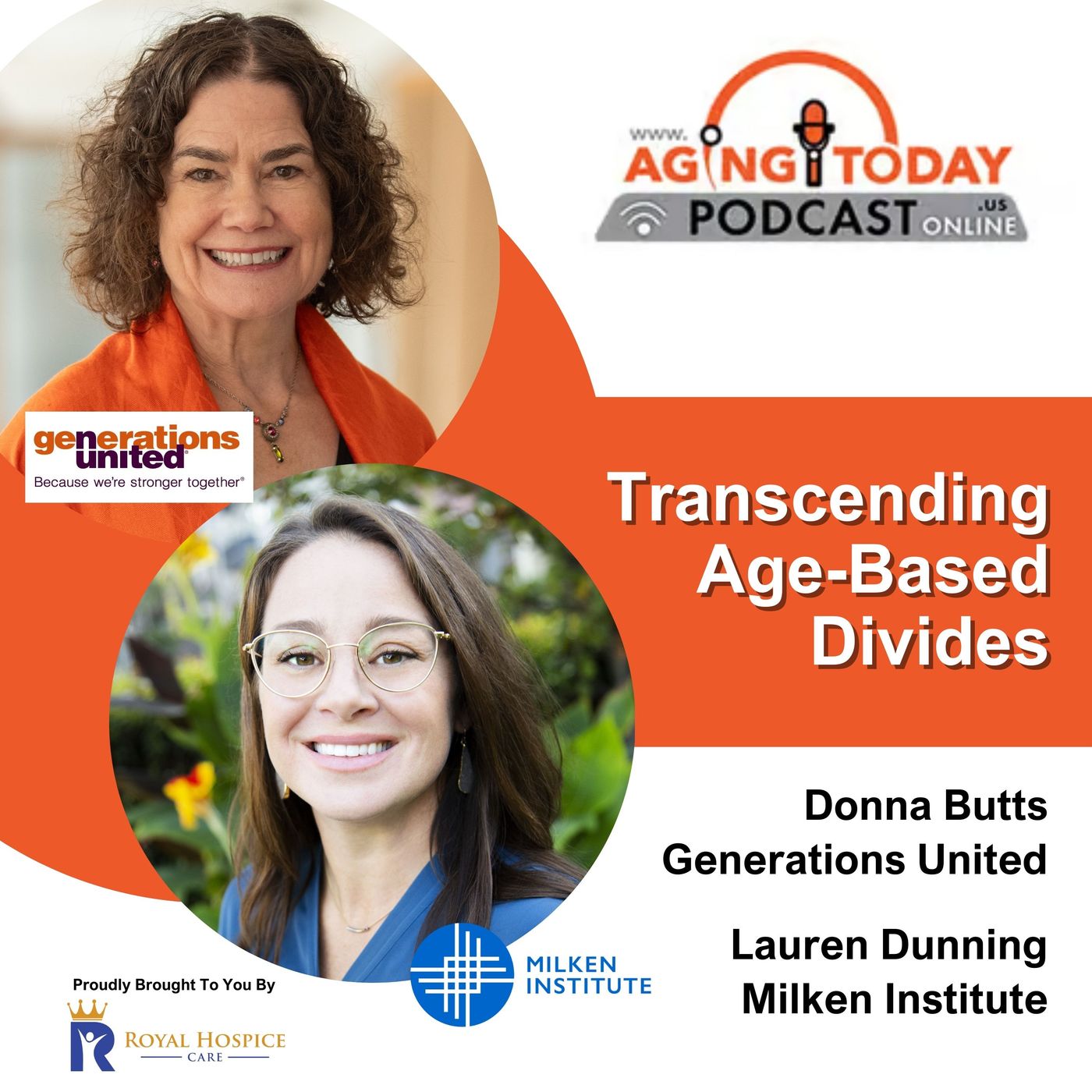
"People want intergenerational connection." - Lauren Dunning
Mark Turnbull discusses the implications of an aging population with experts Lauren Dunning, Director Future of Aging at Milken Institute and Donna Butts, Executive Director at Generations...
"People want intergenerational connection." - Lauren Dunning
Mark Turnbull discusses the implications of an aging population with experts Lauren Dunning, Director Future of Aging at Milken Institute and Donna Butts, Executive Director at Generations United. They explore the importance of intergenerational living as a solution to loneliness and isolation among seniors and younger generations. The conversation highlights the need for policy changes to support intergenerational connections and the role of social connections in promoting health and longevity.
Learn more about our Guests:
Donna Butts, Generations United: https://www.gu.org/
Lauren Dunning, Milken Institute: https://milkeninstitute.org/
We're proud of 8 years of Aging Today shows!
Thank you to our sponsor: Royal Hospice Oregon
#generation #aging #agingtodaypodcast #society
Buy Mark a Coffee - Support Our Content About Aging!

Like and share Aging Today podcasts with your friends and family!
www.AgingToday.us
0:00 But I think I always think back to what a foster grandparent told me once. And it was care where you are. Your biological grandchildren or grandparents may not be next door to you. But I'll bet in your neighborhood there's a child, there's an older person, and you can care where you are. There's an aging part of our population is aging. And they don't have children. They didn't have children. And having children doesn't make it a guarantee that they're going to take care of you. So who's going to care for us? And it's the responsibility we all share. In our communities that's there for them. And that's what we can all do. [MUSIC PLAYING] And now the podcast we're together, we discuss proactive aging on your terms, connecting to the professional advice of our special guests while creating better days throughout the aging process.
0:54 Now here's your host, Mark Turnbull. Hello, everyone, and welcome back to another lively discussion on aging today. We are the podcast where together we're exploring the many options to aging on your terms. You can find aging today and our past eight years of programming on our website, all you got to do is go to agingtoday.us. That's agingtoday.us. And I just want to say thank you to all of you for joining in on our conversation today. And we do have a lively conversation, another one that comes out every Monday. And this is one that I know you will all enjoy.
1:34 Well, one of the things that many of you know, and if you don't know, that by the year 2030, the percentage of adults age 65 and children under the age of 18 will be about the same. That's kind of interesting. It's an interesting stat. And so my question is, what does that mean to us? And then why should we be concerned? And then what's going to be the impact on our lives? Well, one of the things that we all are interested in, and that is healthy living and longevity to our lives, and there's impacts on longevity and healthy impacts.
2:17 And what we're noticing is that there's an alarming rate of seniors that find themselves disconnected. And that will have an impact on our longevity. We'll have an impact on our health. And I can only say that we're designed to be social. And when we are isolated, we run the risk of loneliness, depression, which can then lead to increased risk of heart disease, stroke, dementia, anxiety, and other long-term illnesses. So here to talk with us through this whole topic of the strategies and the solutions that we all desire for adopting in our personal lives to help us live healthy.
3:03 And with more longevity is Lauren Dunning and Donna Butts. And they are of the Milken Institute for Health. Welcome ladies to Aging Today. Hi, thank you. Yeah, so-- Thank you, Mark. Absolutely. Looking forward to that. I'm actually with-- I do have a disclaimer though, I'm not with the Milken Institute. I'm with Generation United. We're partners and friends and collaborators. OK. And Lauren, you're the one that's with Milken, correct? Yes. I'm Lauren Dunning. I'm with the Milken Institute Future of Aging. OK, great. I'm glad that we got that straightened out and up front so that we give the credit to the right organizations.
3:47 So we always start out in our conversations. We always start out about what's in your story. Let's start with you, Lauren. What's in your story? What led you to being a part of the Milken Institute and some of the history that you've done in taking that track that way? Absolutely. I'll just also briefly introduce it. The Milken Institute's a nonprofit nonpartisan think tank more focused on accelerating measurable progress on the path to a meaningful life. And we believe that physical health, financial health, and the ability to give back are central to this progress. And within the Milken Institute, we have the future of aging where I sit.
4:28 And we're working to advance healthy longevity and financial security for all. And we do that through research convening multi-sector partnerships and the elevation of high impact policies and practices. And I say this because that coming together of healthy longevity and financial security and looking out, looking towards the power of convening, leveraging our partners and elevating really great ideas is something I am passionate about. I'm a lawyer and I have a public health degree. And I previously worked in government. And in working in government, focused on public health and taking care of the health of the 10 plus million citizens and LA County and being a part of that endeavor really helped me understand what are some specific needs related to population aging.
5:17 And that population aging is something that it's not coming tomorrow. And people often speak of it in the same breath as climate change, twin megatrends, they're changing how we live, they're changing the makeup of our societies. And I really wanted to be a part of not only addressing some of the challenges, which there are, but also creating upsides, right? There are upsides, there's benefits, there's really exciting things about how do we increase our health spans, increase our well spans and make the most of these sort of years that we've been given. And so that's why I'm here doing this. And as Donna mentioned, we have an incredible network of partners that includes Donna and Generations United.
5:58 All right. And Donna, how about you? What has led you down this path and this journey to be where you are today? Yeah. Well, thank you, Mark. It's an honor to be here today and so wonderful to be with Lauren who's a terrific partner. My path, I think it always made sense to me because I come from a long line of Midwest ministers and I grew up in Salem, Oregon. And one of my first jobs was directing a teen program at the YWCA. My heart was always with teenagers because they're probably the most difficult population at times to work with. So when I was named as the teen director at the YWCA, one of the programs I inherited was called Senior Outreach.
6:43 And it was one of those in early administration on ageing demonstration programs. And it was coming to the end of funding. And so I was like, at the wise age of 22, if we don't have funding, we'll just end the program if we can find funding great. And what the program was, was it took high school sociology students and they visited low-income, isolated older adults who were basically by themselves once a week for a friendly visit program. And what I found, the first time I went for a visit were older adults that didn't get out of bed until the day that they knew their young friend was coming. And teenagers who skipped school, except for the day that they were gonna go see their older friend.
7:26 They both had purpose, they both had meaning, they showed up for each other. And those semester-long relationships went on to last lifetimes. So I just found it was such a powerful, powerful program. So as my career progressed through other teen work and youth work about 27 years ago, when I was poking around talking to some national leaders here in Washington, D.C., one of them said, "You know, Donna, we have this new organization "and you might be the right person for this job." And what it was was Generation United had just been formed, actually it had operated as a Looseningit Coalition founded by the National Council on Aging, ARP, Children's Defense Fund in the Child Welfare League of America.
8:11 And they were looking for, really, their first executive director to either sink or swim with this organization. And it has been an incredible honor and thrill to be able to work with committed, fabulous people and be able to elevate intergenerational programs, public policies and practices that connect generations that value people at all ages and stages of life. And I think that our mission and the work of the Milken Institute is more critical today than ever. Yeah, how is the correlation between the two organizations? How does that work and where's the crossover and how you guys got all together? And then you're trying to solve a common problem.
8:52 We are. So at the Milken Institute, we not only do our own research and work, but we do that by engaging experts, right? And so to do that, we have to have a large network of folks that we can partner with to share ideas, to help us build and generate new solutions. And Donna is one of those incredible, incredible people that we do that with. And to also elevate messages together, like we're doing here today. And by the way, thank you for this opportunity to share and to help people, your listeners learn more about intergenerational connection and healthy aging. And so, right, we do that by doing our work and then elevating together, partnering on ideas and getting great messages out there.
9:36 So for example, I just will show them like earlier this year, we published Translending Age-Based Divides, which focuses on intergenerational connection and how it's an important solution for many areas of society where we need action. And then sorry, Donna, I'll just also say, Donna has an exciting new report that's focusing on intergenerational living and housing. And both of those sort of contain sort of complementary ideas and work to help keep elevating and help pushing forward and getting into the right hand so we can help decision makers, right? Make changes and help society reflect what we're all excited to see, which is more intentional ways that we're helping people of all ages connect with each other, including right, through housing and social connection and all different kinds of opportunities in our own communities and other-- - Yeah, I'm always fascinated by all the different and array of organizations out there that are focused on some of the same things.
10:35 And yes, we're talking about the aging complexities and as we're in aging culture, there's so many needs out there. Is the milk, is the milk and institute, is that a private organization or is that a governmental organization? How does that all fit in? - Absolutely, we're a private organization where a nonprofit organization and our work is focused on, right, research, convening. We host incredible events bringing together experts. Such as Donna, we got to see Donna last week at our future of health summit, where we had a conversation on health, place, and aging in community.
11:20 And so that's just a brief explanation, Donna, I don't know if we want to say a bit more about generations united. - Well, I would just say, Mark, that as generation united, as I mentioned from our very beginning, we were formed as a collaborative and we really do believe that the strength is in when we work together, that we're really stronger when we work together and that we shouldn't compete to do good, that there's enough space for us. So a lot of our work is in collaboration and the sort of the analogy sometimes I use and being an organian, you might understand this, is an intergenerational can be everything or nothing. It's kind of a, you know, a times difficult to explain.
12:01 So the approach that we take is we barnacle. We attach to issues and we attach the lens, the intergenerational lens and perspective and partner with really good people and really good organizations and look at how an intergenerational solution helps to address so many of the issues in our country. So it's really a thrill to be able to work with Milka and institute Lauren and her colleagues. - Now, the focus today in our conversation is on, you know, solutions for loneliness and isolation. And one of the tenants that you're putting forth is the concept of intergenerational living? Am I correct in that framing that our conversation today?
12:44 - Yes, you are. We both in those lovely reports I just showed that folks can find on our respective websites. They both handle and discuss housing as a way to increase intentional intergenerational connection and also by having that type of proximity, it can support building intergenerational relationships, which as you mentioned, have important and unique benefits. And, Dawn, I know you've done lots of research on intergenerational connection and I think one of the most important pieces I just love to start with is that people want intergenerational connection.
13:27 Eight in 10 older adults is looking to connect with someone from a different generation. And so we have to start there knowing that many people might not perceive or know or think that people really want to connect across different ages, but they do. - How did you come to that conclusion that intergenerational connectivity was so important to seniors and to our young people? - And to our families and to everyone in between. The research that we did, we actually did a national public opinion survey and asked people questions about, where the responses were, that most people wanted the opportunity to connect with other generations.
14:10 They just didn't know how to do it or where to do it. They didn't feel like they had that avenue. They also thought about if they ever needed care or they needed to find a spot for care for their parents, that they wanted it to not just be single aged. They wanted it to be around children, youth and other older adults, that they're really very vibrant. So when you think about social isolation and loneliness, the fact is it's really our older adults and our younger people who feel the most isolated and lonely. And so when you connect the generations, you're really having much a multiple impact, multiple effect. And when you think about ageism, the two groups that suffer the most from ageism are older adults and young people.
14:53 Young people aren't ready to be, they're waiting. Older adults are done and they're waiting to die. And neither one of those are true. They're vibrant. They have so much to contribute. And it's sort of like put me in coach, I'm ready. - Yeah. Yeah. And one of the things I was thinking about as you were describing that is many of our listeners may be saying, oh, what is intergenerational living? And so let's define that. And then we can look back on some of the solutions that it provides with those relationships. - Lauren and I might both have something to add to that definition, but basically with generations you might, there are a number of models around the country.
15:38 And I almost always think of it kind of on a spectrum where it can be intentionally built housing, like for a multi-generational family, or it could be an older adult who chooses to home share with a student. It could be an intentional community like Bridge Meadows where adoptive and foster families live side by side with lower income older adults who's only job is to care about the families. It can be communities that are intentionally built so that the parks and the walking trails are good for people at all abilities and ages that they can all enjoy it. Has that community intergenerational center or space where they can connect? It has opportunities for young and old to engage, whether it's tutoring and schools or doing yard maintenance for an older adult or checking in on your friendly neighbors.
16:29 So it's the intentionality that is really important and we're just seeing a tremendous surge in interest. It takes a while, we've made it too complex by zoning, by policy, things like that, but there are really fabulous innovators that are developing really, really warm and wonderful communities that help people live longer in their own homes and stay connected in their communities. So tell me how zoning and some of the other regulations that we have in our communities that are keeping people from connecting intergenerationaly? I'll offer a converse, which is, some really great trends that are helping people reconnect.
17:13 So during the pandemic, we saw a rise in intergenerational living, more families living together. And right, there's some complex trends happening, including around housing availability and affordability and communities are looking for solutions. And one of those solutions that many cities are taking up are ADUs and allowing many, many different types of properties to have multiple buildings or additional units built on them. And that can be a way not only to increase housing stock, but also enable people to live in closer proximity or to have a larger unit and a smaller unit or to enable maybe families to live on the same property or people that want to rent and create their own intergenerational spaces either on accident or on purpose.
18:02 And so many cities are taking that approach by changing zoning to enable more ADUs, right? And taking different approaches to helping housing arise that meets the needs of many different people. There's other examples as well that are less about zoning and regulation and more about private sector innovation. So for example, there's the idea of decentralized senior housing where there's one example of that is upside, which is a company that has a model that has rental units in buildings that are open and support people being there of all ages.
18:43 But then enable older adults to live practically in those communities by offering the services that people might need as they age and might have some level of need such as for meal support or some level of assistance with ADLs. And that approach can also enable people through private sector innovation to have more proximity. But first, obviously the baseline is being able to have, right, housing that supports multifamily living and that's a part of that equation that you were discussing. And Don, I know that your recent report has definitely some points on this. Yeah, I would add to what Lauren said is that part of how we've made it complicated is that we have really age-segregated or siloed policy, funding, and other services, the way that we live, when in fact we actually live together and we're interdependent.
19:36 So sometimes you'll have a funding stream but it will only be for senior housing. You can't serve anybody younger. Or what we saw during the pandemic, which was amazing to me, were even food programs like meals on wheels could deliver a meal to an older adult but not to the child standing next to them. And a school lunch program, an older person could take a child at that school for the school lunch program but they couldn't eat. So we've really segregated and we need to address that. And that happens locally too. How we give preference to where we will allow a project to site to be built. What is the square footage that's needed? If it's a shared site with childcare and adult day care center, that sort of thing.
20:19 And then how many restrictions there are a lot of the campus-based programs are taking years to develop because they have to hash through both who owns the land, what the restrictions are on the land, and how they're going to connect. So it's really a matter of us, I think, using that intergenerational lens and enabling, encouraging, and allowing people to live the way that we should be living. Yeah, one of my favorite sayings is, when you change the way you look at things, the things you look at change, and essentially, what you were describing right there. And as I was listening to the two of you discuss what each of your agencies do and how you do it.
21:02 And I was curious, I mean, that's a monumental task. We're talking 50 states across 3,000 miles. I mean, how is our your voices connecting all the pieces out there in the practical world and how that's trickling down in affecting change in the way we're approaching our seniors? Well, Lauren, I'll jump in first, and please. I mean, a part of our work at Generation United is we do promote program. We elevate programs of distinction, programs of merit. We set the bar for high quality intergenerational programs. So we build the tent that connects people so they don't feel like they're isolated or they're alone.
21:47 We do a global biennial intergenerational conference, the largest gathering of its kind in the world. That's going to be in June in Louisville, Kentucky, this year. We have learning communities around intergenerational living shared sites, grandparents raising grandchildren, but we build those communities. But we also focus on policy because if we want something to last to get it embedded in policy or to change policy, really does help to support and raise awareness and possibility in people's eyes. Now, does that policy then? You have relationships with individual states and governments and the impact of your messaging is that on a federal level, is it on a state level?
22:34 And then how are what we're talking about, these policies being instituted to affect change? Yeah. So that's a deep question. That's a deep question. I sat on the other side previously, and I know that I always looked to write experts in the field that were working directly on specific issues when trying to solve an issue. And so looking at people's sort of working with experts, doing research and reflecting back, new thinking, elevating ideas from other places, so having resources that bring all that together and make that available can really help the job that folks in government who are passed with policy making, how they do their job.
23:25 So it's supportive. It helps get information that is pretty specialized in many ways into the hands of people that can take action. And that's really what we're up to is using that research and convening power to elevate ideas, elevate policies and practices that we want to see spread, and also build and architect and give some prototypes or directions for how do you make some new things that might also help along the way? And so we do that by publishing, just like the brief, I showed you, we do that also by doing this. We do that by, we have a great government affairs team that can provide information directly to folks when there's something relevant, commenting on what's going on in the world.
24:08 There's some exciting, right, policies, stuff going on at all kinds of levels, right? The Older American's Act is being renewed. Recently, there was a blueprint that was a scoping document for a national plan on aging. That's a federal plan to guide, right? How the federal government addresses aging across all kinds of domains. And we've seen things like that for other areas, such as Alzheimer's and caregiving. And so thinking about it from an overarching level for aging is a really exciting proposition. States are creating multi-sector plans for aging that include housing. And there's many, many ways that they're gathering input on that, including by checking out all of sort of these exciting documents and then also by getting direct input from stakeholder groups and from other groups like think tanks and nonprofits such as ourselves.
24:59 - Yeah, I'm always fascinated by the voice and you have to have that voice. And you're the voice of two in the wilderness and you're saying to the world out there, hey, we have an issue, we have a problem. And the problem is that as our population is aging, along with the aging population, is being as high as it is and then also you've got the younger generations, they seem to be as equal in terms of numbers and percentage of our population. And what you're trying to do is to bridge that gap so that you can affect both populations.
25:39 'Cause I think one of the things that we've lost in my opinion is the whole concept of honoring your mother and your father. And when we disconnect from our aging population as young people, I think that has a negative effect on our culture and not in a good way. And I think that's what you guys are addressing. - Mark, you're really right because one of the benefits of intergenerational programming is that you ask a child or a young one who's been in an intergenerational program, show them a picture of a seven year old and a 70 year old and they're gonna look at both of those and say, that's my friend.
26:22 When they're exposed, when they grow up, they don't look at the differences as something that matters. They also learn soft skills and their patients, they learn more communications or more accepting of people with disabilities. And then for older adults, they see hope in the future. So again, just from a very early age, but I think that when we think about policy, there's so much that we can do at the federal level, but so much as state and local. The one thing that I really appreciate about intergenerational work is that it really cuts across party lines because we all have had aging parents or we're all aging or we know people, it's our neighbor, it's that sort of thing.
27:03 So you can really build common ground. And so what we try to do similar at Lauren was saying is elevate the models that we see around the country. For example, Nebraska just passed a state, a state law that they're providing a certain amount of money and incentives for people who are building senior care facilities with childcare centers. And they're doing that because the workforce, the caregiving workforce is really a very tough area to recruit in, it's a tough area to retain people. And by providing childcare, the workers have a place to take their children, they stay connected to their family and then the children benefit by their exposure with the older adults.
27:48 So I love seeing states that are taking progressive, but not progressive so much as proactive stances to be able to make sure we're connecting generations. And those are common sense things. Did you know that many factors, not just those we typically think of like diet, exercise, and not smoking contribute to health and longevity? One critical area is social connection. Lacking social connection is as dangerous to our health as smoking up to 15 cigarettes a day, interacting with friends, family, and neighbor staves off the very real impacts of loneliness, which is associated with increased risk of heart disease, stroke, dementia, anxiety, and depression.
28:32 This, did you know, segment was brought to you by this week's guests and sponsored by Royal Hospice of Oregon? And those are common sense things. I mean, I'm in the in-home care agency, I have an in-home care agency and a hospice agency. And so I understand the tension between not having enough caregivers and oftentimes caregivers, they're young mothers, they're young fathers. And what keeps them from showing up to work on a consistent basis is childcare. And I love the solution that Nebraska is doing. And I think that should be pushed out to all the states and providing, you know, if all of our institutions, you know, our long-term care communities had that ability to provide some care.
29:22 And again, I don't know how you pay for all that, but it's, I, but I get the concept because the long term effect of that is, is, it's intergenerational. It's going to affect our seniors, but it's also going to affect, you know, one of the things I'd like to say about myself and I say this with great pride is that I'm a privileged man and the reason why I'm a privileged man is because I grew up in a home where we live out the intergenerational care for my, you know, I grew up around grandparents and I grew up, and I'm taking care of my mom currently in her home so that she can live her days on her terms the way she wants to live out her final days.
30:07 And yet at the same time, I take great pride in that, but I'm also aware that the majority of our population doesn't have that ability, they don't have intergenerational relationships with grandparents or maybe those intergenerational relationships with grandparents are, you know, out of state. And so how do you, how do you live that way? I mean, it's just, it's crazy. You know, it's, I think, and thank you for everything you're doing, Mark, I mean, that is terrific 'cause not everybody has that opportunity, but I think I always think back to what a foster grandparent told me once and it was care where you are.
30:49 Your biological grandchildren or grandparents may not be next door to you, but I'll bet in your neighborhood there's a child, there's an older person and you can care where you are. And I think that's a conversation that we're having more and more now because people are thinking about people who have not had children. You know, there's an aging population, part of our population is aging and they don't have children, they didn't have children and having children doesn't make it a guarantee that they're gonna take care of you. So how are, who's gonna care for us? And it's the responsibility we all share in our communities. I love, my husband is retired and he spends a lot of time checking up on our former housekeeper who's 95 and our former neighbors who are 80 and he engages regularly with them.
31:33 He's that extra pair of hands and heart that's there for them and that's what we can all do. - Yeah, absolutely. - And so much of how you make those connections, it's great if they happen organically and sometimes they do from shared activities or interests but because so many things are siloed, we also aren't afforded those opportunities, right? To develop those relationships intentionally and so the more that we can create conditions, right? Through intergenerational communities that involve, right, strategically planning to have multiple generations be there that have sort of all the sort of incentives that financially that help and support people to live in intergenerational communities and then programs that help people connect in a structured way so that they can build those relationships because, right, it is, it does change your life in your perspective, right?
32:22 And once you sort of do it once, you go, oh, I can do this again, right? And we all maybe have that person in our lives, right? My gardening partner of passions intergenerational gardening is 97 and we've been gardening together for about 15 years and I think, you know, when I first started gardening at the garden, if you would said, do you want a 97-year-old best friend, I have to admit, maybe I might have been slightly ageist and had a perception that, oh, it's gonna involve so much giving my time and, you know, it'll be an outlet, I don't want that kind of responsibility. I think people might be surprised that there's giving and receiving on both sides, right? And that we have to remember that it's, right, to make a real relationship, we have that opportunity for both ways, right?
33:08 And that generativity, like the act of, specifically older adults, to younger people, benefits both sides, right? It's a unique type of giving and it provides benefits and so getting ways that people can have that so that now whenever I, you know, I look at the world differently from here on out and I'm one of those people that as, encounter people who might be so waging or meet new neighbors, it's just sort of changed my perspective and capacity as well and so I know that Donna's working hard to make those opportunities for more people in different ways. - Yeah, and, you know, it's real too. As I'm involved in seniors, lives in multiple, you know, multiple areas of their aging as they age all the way from needing a little assistance to all the way to the end of life, it's a daunting task as we age and, you know, one of the greatest fears everybody says that seniors fear the most is out living here resources.
34:11 Number one, number two is the fear of falling and, you know, number three, you know what? I think even this is in third place the way I'm putting it but I think that fear of being alone is right there at the top and I know a lot of people in their 40s and 50s may not think that that's that great of a fear but when you're in your 70s and 80s and your abilities are diminishing and you don't have family around you, you don't have a support system, you don't have that intergenerational support, it can be scary. I can only imagine and, you know, when you don't have that power to do anything about it.
34:53 - And a part of why we advocate for intergenerational relationships is because if you only have one age co-horidist friends and your aging with them, then yes, all around you, what you're gonna see is what I call the three P's, pain pills and passing. People are gonna talk about what hurts, they're gonna talk about, you know, what medication they're on, they're gonna talk about who died but you can't do that if you also have friends in their 40s or 20s or there's kids who are running around that sort of thing. So I think what you're, you know, you're right in that people start to see a diminished social circle because they haven't had or nurtured or intentionally thought about making sure they know people of other ages and they nurture those relationships.
35:39 And also that they focus, it's easy to focus on diminishing ability rather than what abilities you still have left and to be able to use those because we've had intergenerational programs where homebound seniors back in the day were the telephone support to after school kids or they were the ones that could, you know, that could wave out the window or they could do, there were things that they could do in spite of the fact they couldn't get out or get around as well as they used to. - Yeah, yeah. - And it's efficient, right? So bringing it back to intergenerational housing, right? We're talking about loneliness, we're talking about isolation, we're also talking about fear of outliving your resources, right, and intergenerational solutions can be incredibly efficient and also just plain joyful way to address so many issues at once.
36:28 And that's why I think that the report, recent report from General Rations United on healthier lives across generations is really important, right, because those two things, right? Where will I live and who will take care of me and then we're gonna add also, how do I ensure that I have the resources to do so? Really is the place where we live, where we age is so central to answering those questions and intergenerational housing can be a really important solution to making the answers easier for people. - Yeah, one of my greatest concerns is, going back to outliving your resources and that is a legitimate fear because I know what I charge in in-home care and I can't even afford my own services and this has got me very concerned is that the majority of our population cannot stay in their own home and that's not much of a choice and everybody should have that choice in that opportunity to stay home or they can go into a long term care community of various kinds, whatever they desire, but it's even, it doesn't matter what model you choose, they're getting prohibitively expensive where people just don't have the resources or they lose their entire estates in the process.
37:51 So somehow, some way is that being addressed by both of your organizations? How are we going to make it affordable for people to live a quality of life because we're living longer? How do we do that? - Yeah, absolutely. I mean, I think that there's a lot of ways people are addressing this, right? And so right now we are doing work on the future of connected care in the home where we're looking at how technology can be an important, we'll call it force multiplier to helping people get the care they need, including remotely, which can address some of the challenges as an expense of providing direct hours of in-home care, and our previous work focusing on the forgotten middle, the group of older adults who have too much in assets or income to qualify for government support programs, but who cannot afford the housing and care that they will need or want, right?
38:51 And so we focused on that group on how can we create financial models and also new ideas, maybe in healthcare partnerships in housing and healthcare can work together to increase the affordability of housing options for the missing middle. And so we are, you know, and have published on both of those topics and we'll keep publishing on both of those topics and also would be remiss if I didn't mention. Mark, we're also doing on caregivers in the workplace, making sure that, you know, looking at aging as an intergenerational issue and aging as a life course journey, right, making sure that family caregivers that are in the workforce that are doing elder care are able to, right, keep, you know, maintain their employment, have support, and see some things in the private sector that might support them and bring some of that innovation we've seen in childcare to people doing all different sorts of caregiving.
39:44 And so we're working on all three of those issues and more about connecting health span and wall span. - And I think that, you know, Lauren said is very important, there's a way we need to restructure some of the reimbursements, some of the ways that we look at funding and change and update some of the policy around that. But there are other things as well. I think there's some really wonderful innovation underway. There's a gentleman named Marvell Adams who is a part of the Eisner Foundation's intergenerational fellows program designed a model of an intentional intergenerational mixed income community so that they actually, the support was there financially to help some of the lower income folks be able to age there.
40:30 And then the home share programs, well not for everyone, for many older adults to have a student in their home to either help them with some of the, you know, have a meal together help with isolation, walk the dog when it snows, but also provide a little bit of income that they need to be able to stay in that home. And some state, one state at least, was looking at how they made sure that home repair dollars were targeted to that population so that their home was in good enough shape to be able to have a student live with them and for them to be able to stay. So I think we're starting to see some beautiful nuggets around the country, but as we've all said, it's elevating those, it's amplifying them and it's also enabling their replication.
41:15 - Yes, I know because the need is growing, right? We know that half of older adults by 2029 that are, you know, will be in the missing middle won't be able to afford the housing and care they need. That's so many people, but there's lots of solutions sitting out there that people are trying to unlock and leverage one of my favorite figures is from a private sector group, but that it's 137 million spare bedrooms, right? You're talking about the possibility of leveraging even some of those to help make housing more affordable and also support connection. - I do have to say, though, Lauren, because I agree with you that it's interesting because if you talk with an older adult and probably to any of us, we don't have a spare room.
41:57 It's our sewing room, it's our storage room, it's this, so we have to be careful about how we frame it. You know, that you have that space that could be welcoming and engaging and you'd have company and build the expectation, because I hadn't really thought about that before that there aren't many people to think, oh, yeah, I have a spare room. It's like, no, that's got my sewing machine or my hobbies or this or that in it. - And that's, as we keep talking about in this conversation, right, lens, right? You had such a great way to say at Mark about changing how you look at it, changes what you're looking at. And so it's definitely not a solution for everyone.
42:38 I think that there's a lot more that can go on in terms of financial models making senior housing more affordable people that are looking at bringing sort of care and decentralized models out into communities and looking at how in housing that's supported through various government programs, how it is more age integrated. I think that, right, that everything is sort of a suite of solutions when we're talking about something that's magnitude. - Yeah, yeah. You know, one of the things I was thinking about as you were describing that because I've been putting a lot of thought into this myself, how did we get here? And, you know, sometimes, and again, this may be controversial, but that's okay.
43:22 We're on a podcast so we can be controversial. Sometimes I feel like we put too much emphasis upon the government to solve our problems. And we've gotten away from the family. And I know that from my own perspective of, and again, I look at it from a place of, I was privileged to be in a intergenerational family that has stayed together. And unfortunately, our culture has over the last 20, 30 years has been talking about how the family is not that important. And now we're seeing why the family is important.
44:02 And so when we dissolve the familial relationships, now we've opened up, you know, an empty hole, and then we have to fill it with something. And then that's where the government steps in. And I don't think that's the answer. I think going back to multi-generational, you know, my children need to take the responsibility of taking care of me. I need to take the responsibility of taking care of my parents. To me, that's multi-generational. And then that can go out, that's in-house. And then there could be an outhouse form of that multi-generational care, which we're talking about is open that up to people outside of your familial, you know.
44:47 And then there's a family. And I don't know, what's your thoughts on that? - One thing is, I think I look at this slightly different than you do, but one thing is that many years ago, the United Nations declared the family as the cornerstone of civil society. It should be respected and supported. And so I think we all agree to that. And what I think about is that really, we started to see the trend back in the middle of the last century that people used to always live in multi-generational households. They grew up on farms that they needed everybody to work. - We used to put that on, yeah.
45:27 That was a great example. - Yeah, the wall, yeah. - And then, and then, - And so we're there going, what's the wall to? (laughs) - John Boy. - But as we started to industrialize, and families started to go to make, you know, so they could make more money so that they could make it in this new society, we started saying that that was the norm, that there was something that was wrong if we were interdependent. We needed to be independent. I always call it the John Wayne mentality, like I don't need anybody else. So we reinforced that, you know, to be independent, that you needed your own home, you needed, you know, that was like success in America. And what's happened, which I love over the last, probably 25 or more years is that unfortunately, there'd been horrible things like the housing, bust and COVID that people, families back together, living under one roof.
46:21 And everybody thought that they were gonna split up again as soon as that crisis was over. But in fact, the numbers of multi-generational households continued to increase. It didn't diminish after the housing bust, it didn't diminish after COVID. And when we surveyed the families, something like well over 80%, so they were gonna stay together after COVID, because if that had it worked, financially, caregiving, culturally connecting to their roots. So I think it's what we have to do is push against the societal norm that we don't need each other because we do. And bring up public health lens, right? Public health is all about creating the conditions, right?
47:01 So how do we help create those conditions, right? Some of it is by right making it so that from an infrastructure perspective, right, we have communities that support intergenerational housing and housing stock that supports aging and place in older adults having homes that have design features and communities that have design features that enable them to be fully included as well as people of all ages to be included. That's the best part about inclusive design as it's not just for older adults, as for everyone. But then also thinking about the conditions, right? Including to support people who might be performing elder caregiving by looking at right the role of employers and how people are supported in doing that work.
47:42 And then also looking at innovation, right? For people that are far away and caregiving far from a loved one. How do we have the technology that lets them have insight and makes it just easier for people to be in contact, connected and mobilizing resources? And so I think there's innovation across all three of those things that are happening and that can help create those conditions, right? Because we need, once again, the public health lens of creating conditions and making it nudges, behavior, just making things easier, smoothing the way, not making it so hard because I think one narrative that you just, you brought it up a few times is that it's difficult to try to put everything together that people might need, whether it's yourself putting together things for yourself, whether you're doing it with your family, whether you're doing it with your chosen family.
48:28 It can be difficult to plan and execute, but there's, like I said, I think resources on the way and people really working on it, including us. Yeah, and that's why I was going to go is that your two organizations are addressing, you know, this whole idea about how we can best serve our senior population and how we can best serve our senior population to fight loneliness and all of the things that go along with that is, is one of the solutions is to bring the intergenerational approach to it, bring in the young people. And so that young people then begin to get this idea and this concept of how what it means to honor your mother and your father, your grandparents, and or just in general older people.
49:18 And there needs to be a respect for the different ages. And then the seniors can bring so much, I've seen it over and over again, I've seen seniors reaching back and down into the younger generations and bring all of the wisdom that they have to the table and the younger generation can benefit from that, for sure. So you've got a task at hand, you got the present and you've got the future voice. Presently you're working on the intergenerational thing and other things I'm sure as well. Where do you both see this conversation going into the future and what are some of the future things that you are looking at and recognizing that we're going to be faced with, you know, 10, 15 years down the road? Because I'm at the tip of the baby boomer generation. I'm on the tail, you know, I'm wagon the dog, if you will. I'm 67 years of age and you know, it's the biggest population that we have. And so how are we going to dress this and as you're bringing these concepts to the table currently, then what are some of the things you're looking at for the future? Well, I'll just start absolutely. We are excited about looking at the future and of aging, right? And that involves so many things connecting health,
50:49 spend, and we'll spend. And many of the things we've talked about today are about how do we better integrate our home, taking care of our health and the care we might need. And how do we do that in new configurations that might help bake it more affordable, more accessible, and really meet our needs better while at the same time, you know, addressing the intergenerational nature of aging, right? It's about people across the life course. And so we're looking at different types of innovation on that. And as I mentioned, connected care. So, right, looking at the home is a side of care that brings together, right, how people get care, right? And not all of its health care, right? It's some of its care for activities daily, living some of its care for just how you're living your life, social care, how are you connecting with people? And sort of looking at new ways to bring all of that together with the home at the center. And so technology will be a huge enabler of that. And we're taking a look at how all of the technology that's on both the health side and on the consumer side might fit together in ways that integrate and also sort of build on the models that we have for being able to afford it, including those in health care and other types of insurance. So we will be talking about that more later this year. And we remain very excited about that as we look at how we support older adults and caregivers as people are aging. Thank you.
52:17 Well, I agree. We're also focused on intergenerational living because it's consumer driven. It's what people want. So I think in the future, in my ideal future, we would do a way with gated senior only communities and that we would incentivize people and make it possible for them to live in age-integrated communities and see the value and the benefit of that. And I think a part of it is when we think about age-cigricated, I guess I've been thinking more lately about age-sellerated, accelerated age-sellerated. That's any time we're looking at an issue in this country, we need to look at it with that intergenerational lens, whether it's concern about the environment, whether it's concern about the discourse in the country right now and the conversations that we're having.
53:07 It's making sure that we're looking at it from that age perspective. We don't have to tackle transportation for older people. We need to tackle transportation for all ages. We don't need to tackle hunger for older people. We need to tackle it for all ages. So how do we come up with those intergenerational solutions? So we're going to continue to advocate using that lens and elevating examples that show how powerful it can be. Well said. Lauren, if some of our listeners would like to learn more about the milk and institute, how would they best do that to dive in and see what you guys are doing? And then also if they want to connect with you, what's the best way to do that?
53:49 Absolutely. So we're milkandinstitute.org and we have our publications on our website. We also, it's really exciting. We have credible flagship events that bring together experts and leaders talking about timely issues and across all different areas. And they're actually available on our website. So you can listen to Penny Pennington from Edward Jones talk about retirement with an incredible array of other experts on the stage, including from TAA and Trans America. So you can watch it. It's right there for you. And so folks can check that out. And then if you want to get in touch with me, my email is l. Lauren Dunning at milkandinstitute.org. Always enjoy interacting with folks. And thank you for having me here today. Yeah, absolutely. And Donna, how about you? What's the best way to connect?
54:36 The best way is to check out our website at gu.org. We try to keep it simple. Just gu for generation genited.org. And on the website, you'll find out you'll learn about our learning communities that usually meet quarterly and they connect people around the country. We have an intergenerational program database that you can search by your city, by your state, what programs there are. I'd really encourage people who are very interested in this to think about the global conference because it only happens every two years. And it'll be in Louisville. So we tried to make a kind of a central area in June. And there are ways that you can ask questions on the website so that we make sure that we connect you with the right person at generation United. So that's usually just gu@gu.org.
55:22 And my emails on the website as well. But I always like to say I work with an amazing group of people. I'm usually not the one that knows the most. Yeah, well, the mark of a smart woman is not that she knows everything, but she knows where to find out about everything. That's what I always say about myself is the same thing. Nobody knows everything, but that's the mark of a smart person. Yeah. So mark it's been a joy to thank you. And thank you. It literally has. And, you know, so we've been talking about fighting and combating against loneliness amongst our senior population and the solution that you're bringing forward in both of your organizations is intergenerational connectivity and connecting the generations to each other and that will supply some of the and provide a solution to some of the loneliness that seniors are up against in their daily lives because we all want in the in the end, we all want to live our best lives possible. Whatever that means to you. So ladies, thank you so much for being on aging today and your influence is being felt across our great land. And we want to say thank you for all of the efforts that the milk and institute is doing and generations united is doing to make all of our lives better each and every day. So thank you for being on aging today. Thank you, Mark.
56:51 Thank you. All right. This is Mark Turnbull, your host. And I want to thank all of you for tuning into aging today. And as a reminder, we are the podcast where together we're exploring the many options to aging on your terms. Join us every Monday when we release a new conversation on aging today to your favorite podcast channel. And I want to leave you with this. We're all in the process of aging. And as we age, we really are better together. So stay young at heart. ♪ You make me feel so young ♪ You make me feel like spring has sprung ♪ In every time I see your face, I'm such a happy individual ♪ A moment that you speak ♪ I want to go play hide and seek ♪ I want to go and bounce the moon ♪ Just like a toy balloon, well you and I are just like a bulletots ♪ Running across the metal ♪ ♪ Bigger, a lot, so forget me not so you made me feel so young ♪ You made me feel there are songs to be sung ♪ ♪ There will still be wrong and wonderful things to be found ♪ And even when I'm old and grey ♪ You've been listening to Aging Today where together we explore the options to aging on your terms.
58:22 Join Mark and his guest next week for another lively discussion on proactively aging on your terms, connecting you to the professional advice of his special guests with the goal of creating better days throughout the aging process. Your host has been Mark Turnbull. Join Mark and his guest every week on aging today your podcast to exploring your options for aging on your terms. ♫ And even when I was in grade ♫ You make me feel the way I feel today ♫ 'Cause you make me feel so ♫ You make me feel so ♫ You make me feel so young ♫ So young ♫ You make me feel so young ♫ You make me feel so young [music]