

 YouTube

 Apple Podcasts

 Spotify

 RSS Feed

 Spreaker

 iHeartRadio

 Castbox

 JioSaavn

 Pandora

 Deezer

 Podcast Addict

 Amazon Music

Teepa Snow: You've Already Asked Me That!
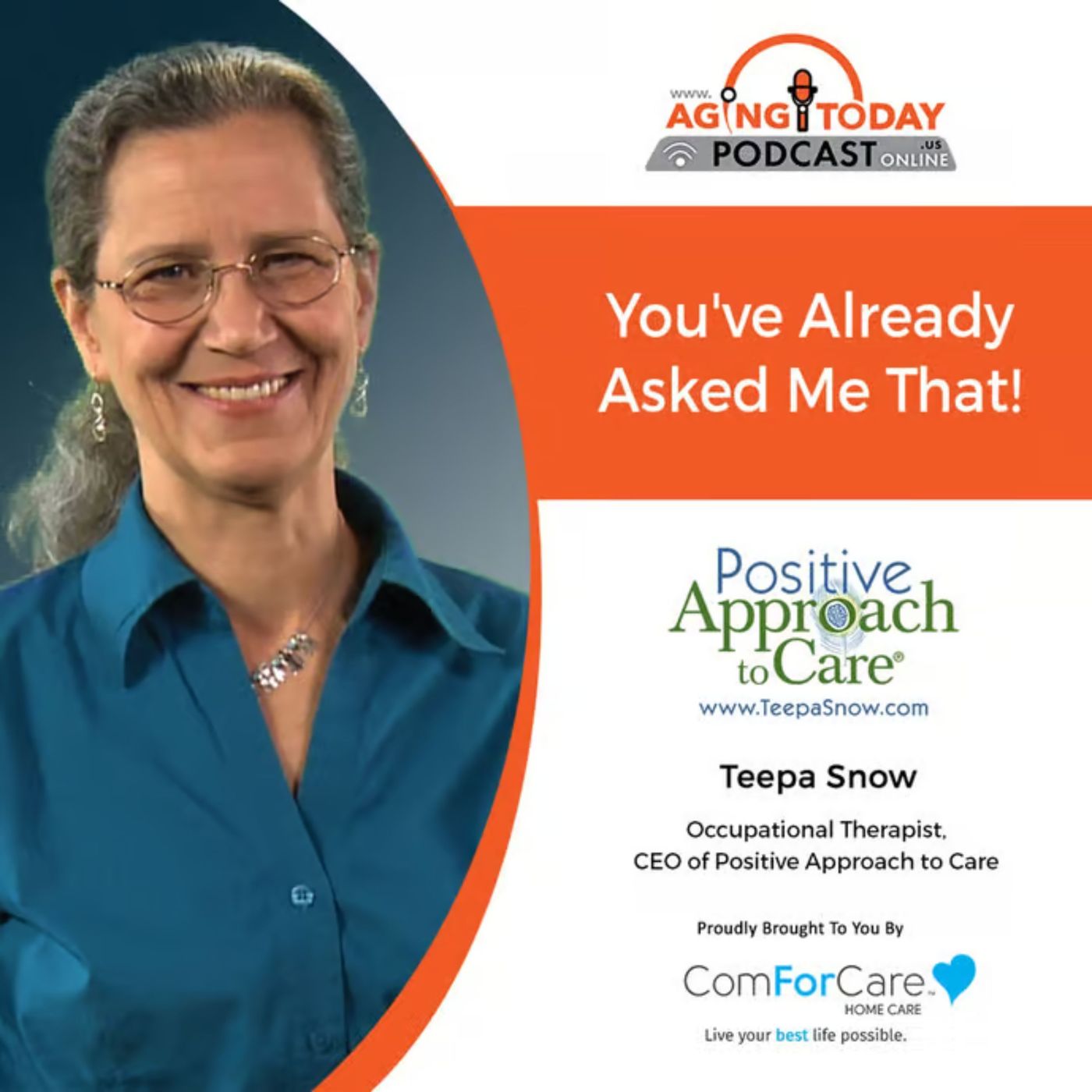
"You've already asked me that!"
Teepa Snow joins us on the Aging Today Podcast for a lively discussion on responding to repetitive questions and challenging behaviors from those living with dementia.
Her unique style and positive approach will help...
"You've already asked me that!"
Teepa Snow joins us on the Aging Today Podcast for a lively discussion on responding to repetitive questions and challenging behaviors from those living with dementia.
Her unique style and positive approach will help you better understand dementia and how it affects your loved ones. Teepa believes that “Rewiring our own perceptions, attitudes, communication strategies, actions, and responses, provides the shift that promotes change for the others around us."
Learn more about Teepa Snow and Positive Approach to Care: https://teepasnow.com/
This is a special repeat episode by popular demand! Original airdate: 10/03/22
Buy Mark a Coffee - Support Our Content About Aging!

Like and share Aging Today podcasts with your friends and family!
www.AgingToday.us
0:00 [music] You're listening to Aging Today, the podcast where together we explore the options to aging on your terms. When I get older, those are my hair, many years from now. Will you still be sending me a fountain of time, for they create us out of the wild? If I had a kill quarter or three, would you like to do it? Will you still be, will you still be when I'm sixty four?
0:42 And now the podcast where together we discuss proactive aging on your terms, connecting to the professional advice of our special guests, while creating better days throughout the aging process. Now here's your host, Mark Turnbull. And welcome to Aging Today. I want to thank all of our listeners for tuning in every week on Aging Today. We are the podcast where together we explore the many options to aging on your terms. You can find Aging Today on our website. All you got to do is go to AgingToday.us and you can go to the library of past programs and follow us along the way.
1:23 We also want to let you know that you can listen to us on your favorite podcast channels, such as Spotify, Pandora, Apple Podcast, iHeart. There's so many of them that were on out there. And you can pick up in the archives, all of our past programs as well. And then finally, I want to hear from all of you, our listeners out there. And I know you've been faithful and following us. We have over 200,000 followers that we've been able to reach out to over the past years. And I know we're not Joe Rogan or we're not Tepa Snow, but we're on our way. And we're just trying to make that impact.
2:03 We want you to know that all of your questions are relevant. And we want you to know that we'll get all of the experts on this show to answer your questions about aging. All you got to do is contact me, your host, Mark Turnbull at mark@agingtoday.us. That's Mark with a K at agingtoday.us. Well, there's over 55 million people worldwide that are living with dementia. And I know many of you have been touched by dementia, either maybe yourself that are living with it in the early stages. Maybe you have friends and family.
2:43 And it is no secret that we all need more knowledge and skills to meet the ever-changing needs of our brain as it is changing for people that are living with dementia. And to help us along our journey today, we have on agingtoday our guest and dementia expert. She is an occupational therapist, a positive, owns a, and the CEO of a positive approach to care program and for training. And her name is, I don't even need to say this is, "Tea us no." "Tea, welcome to agingtoday."
3:24 Thanks, Mark. Thanks for having me. And thanks for doing the work you do to help people hear they're in everywhere from the sounds of things. You know, it is an uphill climb. But, you know, it's interesting. Over the years, one of the reasons we started this podcast was we saw the desperate need of people not even knowing where to go to get the resources. And so that's why it was the impetus of this program and it's grown ever since over the last six years. And so we're excited to be a part of the solutions out there and bringing folks like yourself on that are the true experts out there in the field.
4:05 I think if we all do the best we can and work together, we end up in a place that's better than we were. So I'm glad to be here. Yeah. So, you know, I'm curious. I don't know if you've ever been asked this question, but I'm curious. The name "Tea us no." Your parents were very creative. And I just, I love that. What's in a name? I'm fascinated by name. So tell us the story behind "Tea us no." Okay. Well, my mom was creative, but not that creative. So her, my maiden name was Alman, A-L-L-M-A-N. My middle name came from both grandmothers. Both grandmothers had one for a Lucille and one Lucille Virginia. So I got the batch up there. So I got Lucille as a middle name.
4:53 And they were Thomas, Oris, and Dora Lee. And so they decided on T-L and then Alman. T-L-A were going to be the initials of all the children. And I was the first. And so my mom thought, "Oh, what a, I've got an idea." And so she decided my name would be T-E-E-N-A-T-N-A. But T-N-A is spelled with two E's, nine, nine. And when you put that all together, the meaning of the word and then my name was tiny little light before Alman. That's cool. Well, different. So anyway. But it's in the big picture, it's all been true.
5:39 Well, see, it sort of works out this way, but you don't know. What's in a name? Yeah, so what happened was when I was a teenager, I was working with kids with developmental disabilities. And children with autism and speech problems. And I had a little boy named Michael who couldn't say Tina. He would call me T-PA, T-PA, T-PA. Tell me, tell me, 'cause he had a speech impediment in addition to his autism. And then all my friends started calling me T-PA, T-PA. And so before too long, everyone called me T-PA rather than Tina. And so over time, it became what everybody called me, so I legally changed it to T-PA instead of Tina. And then I married a guy named Dick Snow. And so it's now T-P-S-O.
6:23 So it all came to just sort of line up that way, I guess. Love it. A great story. And just I love hearing the story behind people's names. It's fascinating. I love it. Okay, so for our listening audience, it may not be familiar with T-P-S-O, but many, many people are. Tell us a little bit about your journey. And what roads have you traveled to get to this place where you are the queen or the czar of dementia care? Well, I would never describe myself. But I heard those kind of things. I started off my grandfather moved in when I was a kid and my mom was single parenting at the time.
7:08 And so I became de facto his care provider when she was working. So she was a schoolteacher and she also then led a cheerleading group because she was a fizz-ed teacher. And so I would be with my grandfather for long periods of time. And my grandma had died. And that's when we found out how involved his brain was because at the time we had no idea because they lived out of town and you know, it's like, whoa. So I learned how to do things to keep him okay because if he wasn't okay, nothing was okay. So he would say things like, listen, I've got to get home. Floes looking for me. I've got to get back. I can't stay here anymore. And my mom would say, Dad, what part of mom's dead or you're not getting?
7:54 I mean, this is ridiculous. I told you, remember, look, here's your casket. And I was like, oh, that didn't go well because every time it would be a surprise and he would grieve. And then he would say, that's a lie. That's not true. I'm going back to Cleveland. You can't make me. And so instead, I would say things like, but grandpa, if you leave right now, I will be alone. And I don't want to be alone. Please will you stay just maybe till tomorrow? And he would say, okay, well, I'll stay one day. But then I got to get home. I can't stay here long. And I said, well, just till tomorrow then. And that was sort of the beginning of understanding, you know, I can't fix what's wrong, but I can make different choices. And I see what happens if you make one choice. And I see what happens if you make another choice.
8:41 And I don't see the point of fighting when we can figure out how to make this work better. So that was really, you know, that was family. And so I started with my grandfather. And then we moved on later on, my grandma on the other side, developed Alzheimer's. And then after that, I went for a while before it was back in the family again. And I started working with kids with developmental disabilities and elders who were in a day program. And then I went to my master's program and so it went. And that's how it all started though. Wow. Okay. And then your occupational therapist as an occupational therapist, did you see yourself at that time becoming an expert in dementia care?
9:26 Not so much. I was actually when I started, I was doing head injury and I was doing stroke. So I was doing a lot of neurological changing and what I was really excited and interested was when brain change or their damage, wow, what happens? And how do you help people recover from that or how do you help them cope with that? Or how do you help them live life with that? And then I was spending more and more in time in geriatrics and I started discovering, well, you know, dementia is sort of like brain change. Sort of like, you know, you've had a head injury, but this one is like ever changing and it keeps going and it doesn't turn around and get better.
10:10 But what I noticed is how I could interact with people could really change how they did and how they did in their day and their environment. And I couldn't really change the direction of travel essentially, but I sure could change how they live and how people interacted and how they felt about what was going on. And so it was a gradual shift more from head injury and stroke into the beginnings of dementia, but that wasn't reimbursable under Medicare. So I had to find other ways to start doing that practice because it turned out I like that a whole lot more than trying to set and meet goals according to government standards.
10:50 When was it that that that light went on and you noticed that you have a very special gift to of teaching and speaking in front of groups and taking this message, you know, that is so can be so clinical. And bring it down to the level of of everyday folks like myself. Yeah, so it started when I had finished my master's program and I was starting to work with people in long term care. And I would hear these programs that people would try to deliver and I'd watch staff go to sleep and I'd watch families not get it and I was teaching at the medical school.
11:30 As part of an interdisciplinary team and it was like, hey guys, I don't think this is working. And so I would say, OK, so what I'm going to do is I'm going to stand up in front of you and I'm going to lean in. I'm going to say I need you to stand up and I want you to tell me, how does that make you feel when I do that? And people would say, go, obviously, I don't like it. I don't want to end up you're leaning in and I say exactly. So one of the things that we need to realize is where are we stand and how we say things really makes a difference. And it's not that somebody might have to mention is that as a human being, it's intimidating and it's confrontational.
12:10 So let's try something. I'm going to try something different with you and you tell me how this makes you feel. And what I found out is people learn a lot better when you can engage them in the learning. And even if most of the group is watching, everybody's going, yeah, I wouldn't like that either. And it's like, OK, and then the next thing you say is, all right, so I went everybody to pair up and I want you to try this with a partner and you're going to take turns because I want you to see how different it feels when you're sitting in the chair versus when you're standing and when you're giving information versus when you're trying to get it. Now I'm going to add a piece. OK, you ready, Mark? OK, I'm going to go to the mouth. And your first thought is what?
12:54 And it's like, yeah, and the problem is I took away your consonants and I left you with valves, but consonants are the value part of a word. So when I said, I want you to stand up and come with me and I'm going to take you down the hall. The first instinct you have is to say, what? I don't know what you want. And then if I get louder, it doesn't help because it's a comprehension issue, not a volume issue. And I find it interesting how when we're talking with people that with any kind of a long term illness or, you know, we always raise the volume thinking they're going to understand us more.
13:48 And yelling at someone doesn't necessarily make them more tuned in to what you want is showing at me. Yeah, good point. So that actually happened fairly early on was that I'm a very, I use lots of different ways to learn. And so I could figure out how do people like to learn? And so I started tuning into that. And I found that people really do better at learning when you give them opportunities to use their eyes and their ears and their bodies. And that's what dementia is really all about is trying to figure out how to use your eyes, your ears and your body and your thinking system to get things to happen.
14:29 And what happens when it's not working like it should. Amen to that. So let's break this down. Let's start with dementia for those of our listening audience that may be new to a new diagnosis for a family member on dementia. What is dementia? Yeah, so dementia has some characteristics. It's actually a syndrome, a collection of symptoms. It's not a hard diagnosis. A diagnosis is a specific form type or cause. But what we know when somebody's been identified as having a dementia, it means that while we've hopefully looked at everything, it could be that we can fix.
15:09 And what we have is we have a brain that is starting to deteriorate. It's going to lose, it's going to lose chemistry first. And then it starts to lose its structure. And it can be due to malformed proteins or it could be due to a circulation issues or it could be due to oxygen flow issues. But what we're seeing is that the brain is gradually over time or relatively rapidly depending on the type of dementia. And it's starting to die, a parts of it are dying. Now only parts and as that happens, the cells sort of don't work very well. And then they start dying off and the disease spreads around in the brain.
15:51 And depending on where it starts and how it spreads, it gives us a pretty decent idea about what kind of dementia we might be looking at and what we might notice about, what changes in abilities and changes in behavior and changes in interest and changes in the ability to live independently and the way I always lived before. But also how my emotions are and how my thinking is, what my memory is about. So the tricky part about dementia is people tend to think that dementia is dementia is dementia and it turns out that dementia is unique for each individual.
16:33 And we have probably at this point, we think over 120 forms, causes and types that we're aware of, but they have patterns. And so at least two parts of your brain are actively changing and dying. So they're not staying the same, they're progressing and they're dying. The second thing is that it is progressive. It doesn't stop once it gets started. It doesn't know how to say, okay, that's all I'm going to do. I'm going to stop here. It might stop for a while, but then if nothing else changes, it keeps moving forward. And we don't have a cure for it right now. And finally, you know, ultimately it will tend to progress and progress until there's so much damage that your brain can't run your body anymore.
17:16 So it's considered for sure a terminal condition in that we don't have a way to stop it. We don't have a way to cure it. But ultimately over time, if nothing else takes your life, it will, it is a terminal illness. So in in a nutshell, dementia is an umbrella term. It's a descriptive term of what's happening to one's brain. The brain cells are dying. Do we know what causes the brain to die? What have I done to kill my brain cells? Yeah, well, that's a really good question. We do know that having had a stroke or having had a heart attack or having had some things put you in a risk category for from that point forward, there might be some scarring.
18:02 And so your risk of then later developing a dementia is higher, but it's a 50/50 risk. So, you know, 50% of the time it will turn into something that progresses. But if it's stable, it's not a dementia. So it could be that you have abnormal proteins building up, but what we don't know is what causes the abnormal proteins to build up. Like the amyloid plaque or tau pathologies or sonuclein protein, malformations, but you're getting a lot of abnormal protein and you're getting a lot of brain areas that aren't burning fuel like they should. They are not doing their job as well as they should.
18:44 And so we see good moments and bad moments and we see inconsistent sort of abilities. And then we start to see shut down in certain areas. So we think it's related to a cascade, it's called a cascade event where it starts off with this and then it keeps building up and getting worse. And ultimately that's when we start seeing the behavior. So you could have the beginnings of dementia for five to 20 years before we see the beginning symptoms of your living with dementia. As the brain is being attacked, is it environmental issues that we've put ourselves into? Are there genetic issues that...
19:27 I mean, what's the correlation between those two bombardments? Okay, so well, the first highest risk is getting older, but the alternative that is not good. So, but as we age, our risk goes up for most of the measures except for a frontal temporal dementia, which we can spend more time talking about or we may skip over it. But when it comes to genetics, there are certain groups of people that could have... they have what's called a pre-cnione gene. So they got one of these genes from one of their parents and if they get that gene is called a dominant gene and they will develop dementia at a young age. But other people, they don't have that gene. That's not the thing they have. They do have an allele, a variation.
20:13 And if you get two of these, APOE, which is a certain genotype, and you get two APOE4s, your risk of developing dementia is high. But if you have two, your risk is really low. And if you got three, it's sort of a crapshoot in the middle. And yet there are other defenses that don't depend on your genetics at all. It's environmental toxins. So people who, for instance, are exposed to large degrees of mercury or maybe have other heavy metals. People who've been exposed to certain toxins, they can. And people who consume a lot of alcohol in what we call binge drinking in an effort to manage and control things that are going in your life that aren't great.
21:01 We can actually kill brain cells, kill brain cells, but then we also, for some people, create a craving for that source. I have to ask, I have to ask the what is a lot of alcohol because I love my bourbon, I love my wine and I love my beer. How much am I putting my brain in jeopardy? Yeah, so this gets a little tricky. So part of it is that, yeah, part of it is that when I talked about that, drinking a lot in a short period of time. When you do that sort of, that a large amount. So two drinks for men a day, one drink per day and the right proportion. So if I'm talking about hard liquor, it's about a shot. If I'm talking about a beer, it's a 12-ounce beer, not a buddy can in the old days.
21:48 You know, refer to them. And if it's wine, it's a six to nine-ounce glass, depending on the potency of it. So it's how much alcohol, because alcohol is essentially, it's a thing that you, a little bit, can make you feel good, but it also suppresses systems. And if you do too much, it's actually called alcohol poisoning. So you damage brain cells and, yeah, they can recover sometimes, but sometimes you kill them. And sometimes you then set up a system that it feels good because I can't feel anything. And so it's one of the best anesthetics. You know, it's used in surgery for years.
22:28 And let's get back to the dementia is an umbrella term. And there is a thing called alcohol dementia, correct? There is. And the doctors names were Corsicaff and the Corsicaff syndrome or Vernecki syndrome. Those are two that are different kinds of alcohol related dementia. Just like we have, you know, we also have other ones with Dr. Alzheimer and Dr. Pick and Dr., it was where Dr. Parkinson's is Dr. Parkinson's. So it's taken sometimes from the part of the body that part of the brain is involved, but sometimes it's the physician that first identified it.
23:08 Yeah. Okay. So is it reversible? Is it curable? Where are we at in the science of dementia today? Yeah. Well, as of right now, we do not have evidence that it is eliminated. So I can't eliminate dementia from you, but I can improve the quality of your life. But can I stop of progressing? Well, if you've been keeping up with the stuff, this is what the group like with adjuhelm, the medication and other meds like that, their goal is to reduce the amino, the acetyl, the beta l amaloid plaque in the brain. Whether or not that will halt or change the progression of dementia is still up for debate. The amount of change that they've demonstrated so far is not not exceptionally wonderful.
24:00 So for right now, I think for most of us, we're not looking at as a curable condition or even a fully preventable condition, but we can reduce our risk and we can improve the quality of life. Even if somebody does have the very beginning signs and we might might be able to buy people function, more function in their life for longer, but I don't know that we have anything that says we can get rid of this condition. Yeah, whether it's reversible or curable either way. Yeah. So just recently they came out with one of my favorite medications out there on the market, the little blue pill. So tell us, are you familiar with what they're saying is that Viagra is effective in helping people and what does that mean?
24:50 Yeah, I think it's called wishful thinking or something. I'm not sure exactly. I mean, because I have certainly seen situations where people were attempting to use Viagra, but what it did is to some extent heightened testosterone a little bit, but what that ended up doing for people is make them more irritable, sort of like bread no zone, you know, like use it with caution because wow. It can cause a little bit of release on those emotions and you may get something you'd never intended in that there's not any reasonable clinical evidence that says that little blue pill is going to fix your brain. I'm so sorry. Well, it when it first came out, I mean, you don't care anymore.
25:31 Yeah, yeah, that's true. But when it first came out, I was thinking, well, that makes sense because what the little blue pill is doing is that it's putting oxygen into your blood, which gets more into the brain. And so I could see the correlation. Yeah, I mean, and I think that's what we're sort of everybody sort of trying to find this magic way that we can do better. And you know, I'm hoping that sometime we find some stuff. The hard part is a lot of the time it's going to take actually a change in our lifestyle and what we like to eat and what we like to do and how we like to spend our time and, you know, how our society is shifted from a very physical society where we did a lot of stuff.
26:14 But sometimes to access because we were into survival into a society that's got a lot of free time and unfortunately one of our favorite activities appears to be sitting. Yeah, which is not really healthy for any part of the human system actually. Yeah, yeah. And that's where diet comes in. I know we've had several guests on our show, you know, describing a whole food plant based nutrition. And the Mediterranean diet and for sure, all of those things are moderation and helpful. Yeah, yeah. And exercise. We know that physical exercise, our, we were built really with two legs and one high in probably for a reason.
26:57 We're supposed to use our legs twice as much as our high ends and use our hands and our eyes and not be just putting stuff in our mouths but doing something productive. And I think, you know, finding those spaces in places rather than we're so tired, we're so stressed and it's like understood. So let's talk about that and let's figure it out. Yeah, and I think, you know, essentially what I'm learning is that it's a comprehensive approach to addressing, you know, what's happening to our brain as it dies. And, you know, the diet takes a place, takes place, the physical, our physical abilities and then also sleep. Sleep is huge.
27:39 Oh, sleep is huge. Yeah, it's when the little guys get out and start sweeping away all those toxins. Yeah, yeah. And, you know, that's one of the things we think is happening at this point. We think the glial cells are not getting a good shot at doing the cleaning job. And after a period of time they go, I quit. I just, you know, you're not giving me enough time to get my job done. And, you know, so we really do want to be thinking about, okay, are we allowing our brains to heal and recover each night? Are we giving ourself permission to take care of ourselves? And, you know, as carriers, boy, that's a tough one sometimes. Yeah. All right. So the brain is what's happening to the brain. It's dying.
28:21 And as the brain is dying, let's talk a little bit about what it's doing to the person that is living with dementia and some of the implications. There's just like anything else in life. There's the cause and effects. So as our brain's dying, then what are people living with? Yeah. So it's interesting because there tend to be certain areas of brain that are very vulnerable. And so when you have really vulnerable areas, we see those areas often getting taken out first. But what that means is the other areas that are less impacted become big players than whereas before they were not that big on the play. They were just sort of background players, but now they're front.
29:02 So for example, one area that we know is frequently involved in many dimensions is the hippocampal area, which is where you learn and remember new things. It's where you find your way from place to place. And when you go someplace, you know what's going to be there and how you would do something there and then how to get back to the first place you were at. So it's getting around and recognizing how you use something or make use of something in a place and then come back to where you were. And then the last thing your hippocampus is pretty good at is keeping up with how much time is gone by since you last eight. You went to the bathroom. How long has it been since you saw somebody that you really like to see how long has it been since you took a shower? How long has it been since?
29:49 So if that part of your brain is at working, what do you think I might see in you as a human being? What might I notice just from that part of the brain alone? Yeah, and that's where the confusion comes in. Yeah, so I think I just took a shower. I take a shower every morning and it's like, not this morning you didn't. Well, sure I did. No, you didn't. And you would get into without thinking about it will start arguing about what you did and what you didn't do instead of recognizing, wow, damage in the hippocampal area. So he thinks he did because he usually does and he has no idea it's been two weeks since he's taken a shower.
30:29 I go to the store and I call back and I say, you know, I can't, you know, I'm in the parking lot and I don't see the turn to the or the house and it's like, but you've gone to the store forever. Yeah, and in that moment, if you think of it, I went out and now I'm trying to get back and it's my brain is going, I don't know how to get you back. I know how to get you out there, but I don't how to get you back and me calling is a signal that I had awareness and you say, well, mommy, take a right. The tricky part is you're not, you're not sure that I'm at the store you think I am because you're assuming I'm at the store I always go to, but I actually might gotten lost on the way out.
31:15 So that idea that I get lost where I'm going or how to get back and so a frequent term you hear people use is listen, I need to get home. I want to get home and it has a lot to do with I want to get to a place of safety and connection and comfort and I'm not sure how to do that. And so I'm seeking support because my part of my brain that would tell me, how do I get back to a safe place. I think one of the things that I've noticed is that there's, and I understand where this comes from because 80% or at least that's what they say 80% of all dementia are Alzheimer's, which is a memory loss disease.
31:57 And like you said, it's affecting the hippocampus, but, but what about, I mean, there's other factors that I really want to educate people on that there's, there's judgment, there's reasoning, there's balance, there's, I mean, it goes on and on the implications. Yeah, so the hippocampus is one part of the brain, but it's a small part of the brain. It's very small. And so what you're talking one of the first series you talked about was the prefrontal cortex, which is the thinking part of your brain. So this is where you're going to see a shift. And again, I will be impulsive. I will be more impulsive. Maybe than I've ever been. And so I do things that I would never have done or say things or, or I don't control my impulses as well.
32:41 The second is that I lose my ability to take in data and be very logical and reasonable about it. So, you know, why did you put my keys in the closet? Well, why I didn't do anything with your keys, you had your keys, well, they're in the closet. Why did you put them there? Well, mom, I didn't put them there. Well, you must have, because I surely didn't. And I think you're trying to hide them from me, so I won't drive. And so that leap of logic, and it's like, but wait, I didn't do it. You're trying to use, and that's that now combo of the hippocampal damage combined with the not thinking straight. And the problem is neither are we or we quit arguing at that point and go, wow, a loss of memory and a loss of logic. So I need to pause a second.
33:31 Another one is that I can't initiate. I can't get going or I lose my sequencing ability or I lose, how do I stop doing this and move on and do something else? So I'm standing in front of the trash can and I say, what do I do now? And you're like, well, you empty the trash can and I say, OK, and you say, well, just do it. And the problem is, I can't quite think of what's the first step in emptying the trash can. I see it. I know it. I can't figure out that first step. And if I don't know the first step, then I can't do the next step. And you so, you know, tell you what, take the bag out. Oh, OK. Yeah, now I got it. And all of a sudden, I can finish it. And it feels like, well, or you finish emptying the trash can and I'm still standing there and you say, what are you going to do now? And it's like, I don't know what the next thing is. And so that's, that's a hard one because it's so hard to imagine.
34:26 And then there's the other thing in the front of the brain where, you know, frankly, I think I'm fine. And you're like, how did you think you're fine? You wreck the car. I mean, you you burn dinner. You walked away and you let me. And yet my brain is not letting me. It's called anisec nausea. I really am not self aware and not everybody has it. But when you do boy, it's a tough one because I think I'm fine. Or I think I can't do anything, which is the other extreme. And it's like, I need you to take over. I need you to do things. Please don't leave me. And it's like, oh, my heavens, mom, you can do this. No, I can't. I can't. I'm going to make a mistake. Please don't make me do this.
35:06 And it can go either direction, but it means that part of the brain is at working very well. Where in the middle of a conversation with one of America's leading educators on the subject of dementia? Tepa Snow. Tepa has developed a dementia care philosophy reflective of her education, work experience, medical research, and firsthand caregiving experiences. We'll continue this discussion in just a moment along with your host, Mark Turnbull, right here on Aging Today. Sometimes I'd like to smack old age right in the kisser.
35:54 Oh, yeah, still got those moves. I will be fabulous. Comfort care can help with as much or as little home care as you need. From medication reminders and meal prep to everyday chores and errands. Let us create your personalized care plan and find the perfect caregiver match so you can live your best life possible. Call Comfort Care at 503-636-0417. A Did You Know Moment from Comfort Care Home Care of Westlin. Did you know that there are over 55 million people living with dementia worldwide? These individuals deserve quality support so they can live their lives as productively as possible.
36:37 But unfortunately, knowing how to provide the most effective support does not often come naturally. That is why education and skill development is so critical for caregivers, of course, and for everyone in the general population as well. Positive approach to care's mission is to change the culture of dementia care, one mind at a time. For more information, visit www.tepisno.com. This Did You Know Moment is brought to you by Comfort Care Home Care of Westlin, Oregon. Today at 503-636-0417. And now more with Mark Turnbull and his guest, Tepis Snow, one of America's foremost educators on the subject of dementia here on Aging Today.
37:31 You mentioned earlier what is dementia. It's progressive. And so in relationship to what we were just describing, how fast does all of these things happen in an individual? Or is it real gradual? Is it depending on that individual? Talk a little bit about that. Yeah, and so this gets a little tricky because it depends on the individual, the type of dementia, what else is happening for that person? So a person that has diabetes and is hyper-tensive and has PTSD or a mental health condition, then I would anticipate the appearance of symptoms and the up and down of symptoms would be much more variable than somebody who's really aging fairly normally, but they're starting to experience some of the having challenges in the mental health care. So I think that's a little bit more of a campy area in the frontal and maybe even in the temporal where the language is housed.
38:33 And so finding the thing that I wanted to tell you, know what I'm talking about, the whatch macollid. Shoot, what's the name of that thing? So word finding. And maybe just a little limitation in how much visually I can take in at a time. And so we're going to look at that in a very slow way for people who have late later life onset typically. But with certain dimensions, you can be from beginning to end of the dementia like Crossville, Jacobs disease within six months. Some of the prior diseases are very, very rapid and some people with young onset, we see a much more rapid progression in others.
39:15 And so it's very gradual. So it's highly individual, but it's individual based on person, other health conditions, and then the type or form of dementia or dimensions that they might be experiencing. And that leads to a proper diagnosis. And in order to understand what's happening to the individual, because every individual is an individual, where do we go? And to who do we see, what kind of a doctor do we see? So you know, in getting sort of identified, this is not normal aging. This is something more and it really needs to be investigated. One of our biggest challenges is getting into the habit of having a baseline on cognitive ability.
39:59 So we start to notice a shift as soon as it starts to appear so that we could be on top of it. And then we're looking into the symptoms are really getting in our face and getting in our way and causing so much distress. So the better we are, frankly, at picking up on a routine visit with the doctor, just routinely saying, you know, I'd really like to have my cognitions. I want to get it screened every time I'm in, so I sort of know where I'm at. And only one out of every hundred doctor's offices even bothers to do it. Even for people over the age of 65. And even when I know this is like the fifth leading cause of death for people over the age of 65 is like, wait a minute, we aren't doing this.
40:43 And so just, you know, the basics there, but then if we are looking at getting a more specific diagnosis, we should be looking at a geriatrician or a neurologist or a gerious psychiatrist. Someone who's really tuned in and looking at the specifics of what parts of your brain are still working, what parts are not. Where do we see strengths, where do we see in abilities? And what's really important though is what was your baseline? What were you like before so that I have a really clear sense that, yeah, this is not you. This is, and that's why it's important, I think, to know what the pre-look will like. Before we start saying this is, this is this kind of dementia because if you were always distractable and maybe you had ADD or ADHD, then I've got to take that into account when I'm thinking about, well, you know, how severe is the dementia versus what she was already in a situation where her brain had some differences.
41:41 And she was neuro, what we call neurodiverse to start with. So the prescription for Alzheimer's would be a different prescription for frontal lobe or in the other type of dementia, correct? Well, that gets a little, you know, the more knowledgeable your provider is, it should certainly be different. I mean, by prescription, I don't mean necessarily medicine, I mean, you know, just how do you report? How to live? Yeah, how to do that? It certainly should, but unfortunately, we're still in a time and a place that it takes advocacy frequently to get that. Because one of the things we still hear way too often is, well, we went to the doctor and they said she needs to get her affairs in order and to let him know when we need more help with medications.
42:30 I've heard that. Yeah, I've heard. No, that shouldn't be what said. So, you know, yes, we should be doing that. Is it always the case? It often takes a good bit of advocacy to be honest. So get out there and see the right doctor. And I think that's what you're saying is most important so that they can begin to build a prescription for that individual. And it's really, you know, in the case of the people living life. Yeah, for living life with this condition. And it's really living until, until you're not here anymore, because you're going to live until you die. So this idea of let's get your affairs in order.
43:13 Well, you know, at some point along the road early, I do want you to think and you should get a health care power attorney and think about who would be a good person to make choices, consistent with your values. And, you know, is that person prepared and have you talked to them about what you're interested in and want when, and if you're not able to do that, but, you know, frankly, we should be doing that whether or not we have dementia or not. So that's not having dementia. I mean, it's like it should be something we should all be doing. We have that, we all share that fatal disease. It's called living aging. Yeah. And procrastination. Yeah. All right. So, so let's shift gears here a little bit. And, you know, we've talked about dementia. We've talked a little bit about what's happening to the individual and the importance of a proper diagnosis. But, you know, we all have that passion and that compassion for those that are that are living with those that are living with dementia.
44:10 Namely, the caregiver, whether that's a family caregiver, a professional caregiver, and it's important to understand what that person is, you know, diagnosed with and you have to understand a little bit about them as an individual and what their likes and dislikes are. But even then it can be a challenge. Oh, it's a huge challenge because basically I'm asking one brain to take care of your own body and your own brain and somebody else's. But you have to get permission from them to do what you want to do. And it's, but you can't like ask permission like when you're taking care of somebody with a broken leg. Can I get you something to drink and the person goes, yeah, when you get a chance, you know, or, you know, like tell you what, the doctor really wants you to wait there. So how about you get up and, well, okay, you know, it's not that kind of permission because the language center is so impaired because the thinking center is often impaired.
45:05 And so it's the movement center and even the sensory center and the vision centers all sort of getting messed up. And so it's really a very challenging condition because it's ever changing and it's progressive. What would you be your suggestion or how to best prepare somebody that is either becoming a brand new caregiver for a family member or brand new caregiver as a professional. How would you suggest that they prepare themselves for that role? Yeah, tell me what you are liking about spending time with this person and what challenges you because I think from the very beginning, one of the things as we're thinking about this is what's your relationship with this individual.
45:54 What would you like your relationship to be? And the second thing I say is tell me what your support system looks like. What have you got for support? Who do you have support? What's your, both your financial but your environmental support because we need to talk about this because often what people think is, okay, well, I can, I can do this. And without thinking you start down this journey and you have no idea what this is going to look like and you get so far in and you're drowning and you're overwhelmed because you didn't realize how this was going to happen. And I think taking a look about what you like, is this something you're really choosing or do you feel pushed into it? Because this isn't for everybody.
46:41 I mean, and I think all too often we make assumptions about, well, you're the son and it's like, yeah, and I love my dad, but he and I have never, never been good at negotiating how to do things together. And that's why I think it's important that we caution people to take out of their vocabulary, loved ones because many times in family members, there's no love there. No, or I love you, but I don't like you. And it's like, that's really important to know. I mean, a sense of obligation is real different than being able and feel confident and confident supporting someone in living their life.
47:21 And so, you know, it's really looking hard and getting some support in place sooner than you need it to really help you look around and go, okay, so what part of this is good for you and what part you can need help with? Yeah, and this is a great opportunity for a transition here to talk a little bit about your life commitment to teaching people a positive approach to care. And let's talk a little bit about that. And then I want to get into some real specifics about behaviors and how to respond to specific behaviors. Yeah, so some of our essentials is that we believe that care is about a relationship and that we want to have compassion. We also want to be authentic.
48:09 You know, we need to really, really appreciate what's happening for both of us. And we've got to stay curious. And the ultimate goal is to empower people. I mean, really, when you feel empowered, the energy changes and your ability and willingness to engage with me is different. But when you don't feel empowered, when the power shifts, it's like, I said no, when it's like, I heard you know, all right. Okay, that's better. That's easier said than done, Tepa. It's sure not because when it's usually I know what's best for you. Your brain is dying and you don't know what's best for you. So I'm going to will myself over you.
48:53 And that never ends well. It does it. And that's like, you know, if I were your parent before, you know, you know, there's lots changing. Unless I turn around and say, okay, I'd like you to be my parent now. And I'm going to take on the kid roll. And let's have made that commitment to you. Here's the heads up. I still think you are not the boss of me. I brought you in this world. And I'll be happy to take you right back out of you. Keep this up. Sure enough, we get into shouting matches, pushing matches, we get into frustration and anger. And it's like, oh, that's not a way anybody should live. And we're talking hours and days and months and years sometimes of doing this.
49:36 So we've got to get to a place of some comfort. And yeah, everybody should experience discomfort, but nobody should live in distress. Whether you're the one living with dementia or you're the one living with the person living with dementia. Distresses and it's really not a good thing for anybody. So one of the first things that you guys teach is that anybody living with dementia can't change, but me not living with dementia. I can change. Is that what you're telling me? And so I need to, you know, I mean as much as I don't like, but, but, but, but, but, but it is like, but his brain is dying. I mean, if you could do it differently, all right, but that's not what I'm seeing here. So let's try it on this side, because I can't make him be different. Can you choose to be different?
50:24 So talk about something. Yeah, absolutely. Sometimes the answer is no. And I say, well, you know, then try stepping away because right now, probably being there is more risky and dangerous for both of you, then stepping back. And that's hard. That's really hard, but sometimes step away because that's going to do nothing but aggravate both of you. Yeah. How do you, how do you teach that in your organization with a positive approach to care? Yeah. And so one of the things we do is we actually do hands on like role playing. So when I stand, like when I start, I'll stand and I'll pull on your arms. What's the natural tense when I pull on your arms? Will you pull back?
51:04 Okay. So is my pulling on you helping you want to get up with me? Or if I shove my hand that you have any of your surprise to see a hand coming at your face? Well, this is what I call help, but for you, it's like, what are you doing? And if I don't recognize that you can understand you need help, then my offer of help doesn't feel helpful. It feels intrusive, rude. This is not okay. And so I've got a pause for a second go, okay, that didn't work. We work from mistakes. Mistakes are what we learn from. So being willing to go, wow, that shirt didn't work. And it's like, okay, well, let's look at it. What didn't work? Well, she yelled at me.
51:46 Okay. So when did that happen? So we go back and we talk through a situation to try to figure out. And then we go, hey, I'm keep it. And you are. And your natural tendency is when I go, hey, it's Tifa and you are Mark. Mark. Yeah. And what I'm using is more automatic parts of the brain. Hey, Mark, I have a big favor to ask you. Could you help me for five minutes? Okay. Now, why did you say, okay, you don't even know what I'm going to ask you because I'm a nice guy because you're a nice guy. And what I did is I appeal to the nice guy, not the guy who's wet in the chair that I want to get to the bathroom. Yeah.
52:26 I'm reframing because unless I start reframing, I'm going to find myself really frustrated. You know, it's interesting. We've had many clients that we've cared for with dementia and some of them display more angry responses to a question like that. Like, nope. I don't want to or who are you to tell me who I am. I want to know why I'm here, who sent me, I bet. Yeah. Yeah. Cause you're used to being on your own. Yeah. So this is, this is, you never asked for any of this. Did you?
53:07 Yeah. And you're really not like in one little bit of it. Are you? Not a bit. And you know, right, I don't blame you. I don't blame you. I can tell you something if you're interested. Okay. Now, why did you say again, what are okay? Because I'm curious and you're curious. How did I get you curious? You got you led me down a path of curiosity with it. It wasn't confrontational. It wasn't a command or a demand. You had a conversation with me. Yeah. I was compassionate. I was like, man, I bet you didn't even ask for this. And you don't like any of this. I'm not, I mean, I'm like, I got it. Here's the thing.
53:50 If it's not me, I think they'll probably send somebody else because I think everybody's worried. So I'm going to ask you for a big favor. Can we try something and see how we get along? I mean, I understand you don't want anybody. I got that part. But I don't think everybody's going to give up that easy. I'm going to be honest with you. Can we try something and just see how it goes? Okay. All right. So tell you what, I could use your help for a couple of minutes. Would you come? I want to, I want to show you something because I was really amazed when I saw this and I came in your house. And I noticed this. Would you come look at something with me because I have not seen this in very many homes.
54:30 Okay. Now all of a sudden, what are you doing? Which you may not have wanted to done at all? You were sitting in your lounge or right there. But what have I gotten you up to do here? Well, you got me up to look at something that was familiar to me, but I'm curious what it is. Yeah. You took an active role and interest in something that you noticed. Yeah. Was it about you being wet? Was it about you not having shaved? Was it about you sitting in that chair for hours at a time? Or did I begin to interact with you as though you're just an interesting person and I have this curiosity about something which which I do. On the way in, I made sure I noticed some things that made me curious.
55:14 And I saw it by what you have that there are things you really care about. Okay, but let me push back on your teeth. Okay. So, but my company, I'm a professional caregiver, sent me in to do a task and that is to get you in the shower. Yeah. And so my whole focal point as a caregiver is about a shower. Yeah. So who set me up to fail as a caregiver? Yep, the company. Absolutely. Yeah, because this is this and who's asked me to get in the shower, the family. And the first thing that I noticed back, that whole focus is like, well, we got to get the task done. It's like, no, you got to set up a relationship because I don't know of many people who on the very first date want to get make it with somebody else and they keep their clothes on and you get make it.
56:00 And we do whatever we want with your body. I mean, that's actually got a bad rap going for it. And, you know, in most situations, if it weren't dementia, we'd call it taking advantage of somebody on the first date. And especially from the generation of the World War II generation, they're very secretive, very private. Private generation. Yeah. Oh, whoa, whoa. And we don't like us hippies. That's for sure. Not like the hippies who are like out there in their underwear or be naked, dancing in the rain. Yeah, no, this is not that group. And, you know, and I don't know as I've gotten older, I'm a little shy or about, you know, coming wide open. And I'm like, yeah, I can think I'll get that top that goes down over your hips.
56:42 Yeah. Which makes it, which totally makes sense. And this not only applies to caregivers, whether they're family or professional caregivers, but it also applies to home health. And we've, I've seen time and time again, nurses coming out. And they're the only thing that they're interested in is checking the box. I got to do this. I got to do this. And I just, I just go stop, stop with this. You didn't do anything to connect. You didn't greet. You didn't connect. Yeah. Why would they, you know, get out of my house. It's like, well, I mean, you didn't actually get your, you didn't knock on the door in way.
57:24 You didn't put your head around the door and go, hey, it's Mary. May I? I mean, you didn't do anything that said, this is your territory. And if I went and I got in your car and I start going through your purse, how many are your wallet? How many of you would go, whoa, wait, what are you doing? Yeah. And yet I'm supposed to let you come in, get in my underwear and start doing it. It's like, wait a minute. Whoa, whoa, whoa. And poking and prodding and taking temperature. And I've told, I've told so many home health workers do not ask them what day it is, do you know? What day it is? Do not ask them the time. Do not ask them who the president is. Do not do that unless you want to get a fist pair.
58:07 I mean, do you really want to set us up so we establish I'm incompetent or you're asking me things that make it sound like you think I am? And now you're going to turn around and want me to do something. Forget you. Yeah. But they come back and they say, well, but I'm required to ask those questions and I go, no, you're not. There you are not. There you are not. There are other ways to get that data. You can still get that information later. Yeah. And there's so many different, you know, non-intrusive ways to do it. Yeah. For sure. Yeah. Okay, so I'm very curious. I went into a situation where I went into an adult care home, long term care community.
58:50 And we were playing music. And we had a caregiver that played the cello and. Oh, wow. And we were interacting and one individual kept saying over and over and over again. This is so fun. What was your name? And they, I'm serious. Every break in between songs. What was your name? And what do you do when you got these repeating questions over and over again? And how do, how do people, how do you coach people to respond? Yeah.
59:30 So we finished the music and you say to me again for the 15th time. You say to me, so that was so much fun. And what is your name? And I'll say you're one to know my name. I am Tifa. And you are Mark. Mark. Now, Mark, let me ask you something. Are you enjoying the cello or do you like other music instead? What was your name again? You're wanting to know my name. Yeah. I'm Tifa. Oh, hey, Mark. Would you do me a big, come with me. I want to show you something. Because what I'm going to do is say, I've looked around the room and I noticed that people are really irritated with Mark.
1:00:15 People are tired of Mark asking the question. I'll answer the question as many times as Mark wants to ask it because I get that Mark wants to connect to me. We finished the song, which is an indicative. He knows what he's supposed to do all the music is going. But when the music stops, he's trying to be social. And his depth of skill is almost nothing. And so what he has is the social greeting of, that was lovely. And what is your name? And I will say you're wanting to know my name. I'm Tifa and your Mark. Oh, hey, Mark. And now I give a come along cue and we move somewhere so I can give him something else to engage with for a little bit.
1:00:58 Because what I might also do is start sit and holding his hand or putting my hand on his shoulder while he's listening. And stay physically connect him while he's listening to the music. And as the music finished, I said, that was super wasn't it? I love that music. Wow, that was good. He Mark and see if I can guide him that way because I'm already in connection. And the other thing is we would say, what is your favorite music piece? And would you like us to play it and Mark or we'll play it for you? And that's creating that dialogue, correct?
1:01:40 That's that next step. That's the thing that people are looking for. Now you have to be ready for it. I love you are my sunshine. I love you are my sunshine. I love you are my sunshine. Because unfortunately when I go to the file cabinet and I look for all the things I should have in there, the only folder I can find is the one Marked you are my sunshine. And it's like, what I don't remember is I just heard that. Yeah. And so it gets, you know, it can be. I mean, for sure, it can be really hard sometimes when you have a mix of people in the situation, or you're tired of listening and then I'll go, oh, I'm going to give you another one. Listen to this one. See if you recognize it. Yeah. And, you know, try to get his brain to go in a slightly different direction.
1:02:23 But be prepared for a repeat if he likes seeing you and when he sees you, he wants to know who you are. And the other thing to think about doing is putting on a name tag on the right hand side, sitting so it's a possibility and then point to your name tag and give him a chance to pick up on the visual cue of your name tag with just your first name. And it's, and he goes, oh, it's TIPA. Well, that's an interesting name. And that's exactly the same comedy next every time. But, you know, again, he came up with TIPA. I didn't have to offer it that time. I just offered him a motion to my name tag. Yeah. And may I suggest also that when people do use a name tag, make your, your letters oversized so people aren't squinting and they can see it.
1:03:09 And keep it up on your shoulder. Don't hang it down on a land here because they're looking lower than you want them to. And then you're surprised when they reach out and try to take something. And it's like, well, you guided them to the where the good stuff is, you know? Yeah. Are there any other repeating questions over and over again that? Have you seen my mother? Have you seen my dad? Have you seen my mother? Do you know where my husband is? How about TIPA? And those people? And those people? And those people? And those people? And those people? And those people? And those people? And those people? And those people? And those people? And those people? And those people? And those people? Yeah. And those people? And those people? And those people? And those people? And those people?
1:03:49 Yeah. And that's the thing. And those people? Yeah. And those people? Yeah. And those people? Yeah. And those people? Yeah. And those people? Yeah. And those people? Yeah. And those people? Yeah. And those people? Yeah. And those people? Yeah. And those people? Yeah. And those people? Yeah. And those people? Yeah. And those people? Yeah. And those people? Yeah. And those people? Yeah. Yeah. Yeah. Yeah. And those people? Yeah. And those people? Yeah. And those people?
1:04:29 Yeah. And those people? Yeah. And those people? Yeah. And those people? Yeah. And those people? Yeah. And those people? Yeah. And those people? Yeah. And those people? Yeah. And those people? Yeah. And those people? Yeah. And those people? Yeah. And those people? Yeah. Yeah. Yeah. And those people? Yeah. And those people? Yeah. And those people? Yeah. And those people? Yeah. And those people? Yeah. And those people? Yeah. And those people? Yeah.
1:05:09 And those people? Yeah. And those people? Yeah. And those people? Yeah. And those people? Yeah. And those people? Yeah. And those people? Yeah. And those people? Yeah. that what you're saying I've seen that so many times, yeah, then it creates conflict. It's such distress. And you know she, I either argue with you because that's not true. Or then I grieve it's like, well why didn't nobody tell me? And it's like and then were tempted to say "Well, mom, you're at the funeral, what are you talking about?" And it's like, I'm talking about brain failure is what I'm talking about. My brain doesn't hold onto this, and I'm really missing him and you're not helping. You're making me feel like you don't love me either.
1:05:50 All I do is thinking you mad and all I am is scared. Yeah, so many times family members have said, well I can't lie to my dad. How do you respond to that? Well, I'm so sorry. How about mom not being here anymore? Yeah, mom is in here. So what I do is I don't do the lie. So we don't need to lie. When mom, when she says, have you seen my mom? You're looking for your mom. Yeah, yeah. Do you know where she is? Now you're looking for your mom. You're not sure where she is. Do you need her for something? Or you just miss in her as in general, and you just love your mom? Now is your mom a good cook? I change tents, but I do not lie and say, well your mom will be here in 15 minutes.
1:06:33 Your mom is at the grocery store. I mean, those I think are risky behaviors because my mom doesn't go to the grocery store. Dad goes to the grocery store. What are you talking about? Because you never know what people do remember. And in that moment, well, why isn't he here yet? Well, he'll be here in a little while. Or he can't come. Well, why not? Well, then sometimes you'll get, is he cheating on me? And it's like, oh dear, oh dear. No, no, no, no, no. He's not, it's like, well, why isn't he here? It's like that. So I'm not a big proponent of lying. And I don't believe you need to. I think what we're trying to find out is why is it coming up right now?
1:07:16 Is she really missing the human being? Or does she have an unmet need that he would have been really good at meeting? You know, what's going on there? What's the unmet need? She's describing for me. Okay, so dad, it's time to get in the shower. I'm not taking a shower. What is it about that generation, Tepa, that they do not like water? They do not like the shower? Yeah. Well, showers are really intense sensory experiences. And they're overwhelming for some people. And you can't see the water. And it's hitting your body all over. But they've spent a lifetime showering. They have. And yet the sensory changes and the cognitive changes and the motor changes make this to, it's much more of a intense experience.
1:08:00 And how many of you are okay with somebody observing or knowing whether you shower? You just do it. And all of a sudden we're all busy and up in somebody's business of getting a shower. And it's like, well, I'll take one later. Or I already did. Or I'm not doing that right now. And so what we've done is we've set it up as an adversarial. Hey, dad, it's about time for a wash up. Now, do you want to do a shower or just want to do it at the sink or maybe get in the bathtub? What's your preference? So give them options. So it's an option in options, not too many? Rarely the people select the, yeah, only just a couple that, and rarely do people select the shower quite honestly.
1:08:41 It's overwhelming. So sometimes I'll wrap a towel around somebody or leave them in a, a Terry to cloth cover because it eliminates the water hitting their skin and it gives them a layer of overlay of protection. And when it gets wet, often people will let it come off. But it keeps the warmth of the water against them too. And a hand-held shower feels a whole lot better than one that's coming off, the ceiling that you can't control. Yeah. And depending on who it is that you're caring for, and it's why it's so imperative that you get to know that individual and their likes and dislikes, is I've noticed that with some of our clients in one in particular is that I never ask them, do you want to get in the shower?
1:09:28 I always say, okay, I start preparing the shower and I just start getting them in the shower and they go right along. But if I ask them, they'll fight me. Do you want to? It's like, well, you asked me if I wanted to and now you're gonna tell me I have to. It is like, that's not the same as, do you want to? I don't know how to explain this to you, kid. This is like not the same thing at all. Yeah. Yeah. It's interesting how all that works. So let's, I wanna finish up with some angry aggression, aggressive behaviors. Okay. How, as a caregiver, do I respond? 'Cause the first thing that happens to me, Tepa, is it, it, you just insulted my intelligence, my ego, my professional caregiving ego.
1:10:15 - Dendrity. Yeah. Yeah, I know, I just, I called it out. And it's like, really in that moment is like, recognizing, I really do not wanna interact with a primitive brain with my primitive brain and I've gotta make my thinking brain turn on. And it's like, wow, they are really not thinking right now. So if they're not thinking, boy do I need to think and so the most important thing is go, wow, you're really angry at me. And it's like, yeah, because basically you're saying out loud what you're seeing, but rather than saying, I'm just trying to help you. That's, I mean obviously if they thought that, they wouldn't be as angry as they are, it's like, you, I get out of here, you want me out of here.
1:11:03 Wow, you really don't like me here. No, okay, I hear you. Well, tell you what, I'm gonna try to get out of here, but right now they told me I need to be here until the shift is over and I get it. You don't want me here at all. I surely don't, or if I'm a family member, I never asked you to come here, you did not. I thought I was gonna be helpful and boy, did that not work out for either of us right now? Paws. And it's given them permission to be angry because they don't like something. And you know, we all have those moments.
1:11:43 I mean, imagine that, you know, your life, you've been this human being that kicked your own way, did your own thing and all of a sudden it's like, and no more, you're now on my turf here. And it's like, mm, that's not working. I often tell our caregivers, if you haven't been kicked out of a house, you haven't been caregiving very long. - Yep, that's the truth. You know, and it's like I've sat on the front porch and then knocked and said, I am so sorry. I hate to bother you. And they're like, well, how sweet, hard for you. (laughs) Yeah, when you're willing to go willingly rather than, you know, resist, resist, resist, and make it a battle, then they do remember your face. (laughs) So be careful about that.
1:12:24 - Yeah, yeah, just talk a little bit about that. So even though they may not remember the conversation that you had 20 minutes ago or an hour ago, but they do remember your face. And if there's an association of a positive experience, they'll remember that more than they do, the conversation is that correct? - That is absolutely accurate. Because what happens is that is stored in a separate part of the brain that tends to be better preserved. So experiences that give you pleasure and experiences that make you really ticked off or angry. So those are things that tend to be preserved more in a human brain, even with dementia. And that's why kids can sometimes not remember the details or misremember details and think certain things that aren't accurate, but boy, they sure think 'em.
1:13:10 Yeah, and believe 'em and they become fearful or angry even when that's not what I'm doing. But it brings back old memories. So you look like somebody they don't like and suddenly they don't like you. You sound like somebody that they like and suddenly they're, oh, you're that lady. It's like a pysherium. And we aren't even sure who the lady is, but if you're looking positive, I'm in for it. - You're a positive approach to care. So if there's a listener out there that wants to learn more about it, and what are they going to experience? Are they gonna experience some of the role playing?
1:13:50 I mean, I see the value and the power of role playing like you just done with us today. - Absolutely. Everyone of the people that are on our team are trained to do interactions in role play. Every one of them take a question and explore it before they would offer alternatives or an answer getting you thinking in a certain direction. We use video, we use interaction, we use all kinds of formats, but our goal is to help people do what they do in a way that works better for everybody involved. - Okay, so if I wanted to reach out, is the best way to connect with you is that through your website or?
1:14:34 - The website, yeah, that's the easiest way and you can tell us what your relationship with the matches and that sort of helps guide us into where to direct you. Or we have an 800 number, they are on the website. We also have a chat line. We have Facebook, we have YouTube channel, and we also have TikTok and Instagram. Lots of ways to connect up. - Yeah, so would I be assigned a particular counselor or particular individual on your team to carry on an ongoing relationship, to share with you my frustrations as I am the caregiver for my spouse?
1:15:15 - Yeah, and so we have a couple of opportunities. We do do groups, we do one-on-ones, they're consulting sessions or we have mentors that work with folks. We also, if you wanna be part of a group, we're more than happy to have you be part of a group as well. Because we know there's all kinds of people out there with all kinds of different needs. And so we're trying to be responsive depending on who you are and what you're interested in and what your availability is. - Yeah, okay, and so there's a lot of flexibility. You're in, I'm in Portland, Oregon, you're in Durham, - I'm in North Carolina. - You're in North Carolina. - You're in North Carolina. So we were at a time frame difference of three hours.
1:15:58 Does that have any impact on my ability here on the West Coast, the left coast to communicate with you on the right coast? - Yeah, not so much because we have, we do have people who work different hours. We also have people who live in different parts of the world. So we have people over in Australia, in the UK, West Coast, East Coast, Canada, Malaysia. We have a pretty extensive reach. - Yeah, sounds like it. And so the website for our listening audience, what's the address? - Tepasno.com, my name with no space, Tepasno.com. Pretty straightforward. - And for our listening audience, if you're not familiar with Tepasno and the work that she's done, it's two ease, Tepasno.com.
1:16:45 And reach out to her and her team. And they can definitely help you with all the challenges that you may find yourself in and trying to understand what's going on with dementia. - Well, absolutely do our best. And if we don't know, we know people to talk to. - Yeah, absolutely. Tepa, what a pleasure to have you on aging today. Maybe we can do this again in the future. I know that our listening audience will appreciate the wisdom and the experiences that you bring to each of their situations. And it's all about living our best life possible. And that's what we wanna do. And that's what your team is all about.
1:17:27 - Yeah, that's for sure the name of the game because we live until we don't. And so let's do it as well as we can together as a community. Because that's where we can make a difference. - Yeah, and the beauty of that community is that we all bring many experiences and resources to the table. And you guys, you're the resource of the resources out there in the world. So we really appreciate that. - You're so welcome. Thank you for being willing to connect and see what we can do to help out. - All right, thanks again for being on aging today. This is Mark Turnbull, your host. And I wanna thank you for tuning in to Aging Today. We are the podcast where we explore together the options to aging on your terms.
1:18:11 Join us again next week for another lively discussion on aging today. And remember, we're all in the process of aging. And as we age, we really are better together. So stay young yet hard. ♪ You make me feel so young ♪ ♪ You make me feel like spring has sprung ♪ ♪ And every time I see your face ♪ ♪ I'm such a happy individual ♪ ♪ A moment that she's been ♪ ♪ I wanna go play hide and see ♪ ♪ I wanna go and bounce the moon ♪ ♪ Just like a toy balloon ♪ ♪ Well, you and I ♪ ♪ I'll just like a bullet tots ♪ ♪ Running across the metal ♪ ♪ Big and a lot stuff ♪ ♪ Forget me night so you made me feel so young ♪ ♪ You made me feel there are songs to be sung ♪ ♪ There will still be wrong and wonderful things to be fun ♪ ♪ And when I'm old and grey ♪ You've been listening to Aging Today, where together, we explore the options to aging on your terms.
1:19:21 Join Mark and his guest next week for another lively discussion on proactively aging on your terms, connecting you to the professional advice of his special guests, with the goal of creating better days throughout the aging process. Your host has been Mark Turnbull. Join Mark and his guest every week on Aging Today, your podcast to exploring your options for aging on your terms. ♪ And you and I will be grey ♪ ♪ You make me feel the way I feel today ♪ ♪ 'Cause you make me feel so ♪ ♪ You make me feel so ♪ ♪ You make me feel so young, so young ♪ ♪ You make me feel so young, you make me feel so young ♪ ♪ You make me feel so young ♪